Midewin National Tallgrass Prairie
The place
Start with the practical part, because it is unusual and it decides your trip: Midewin is day use only. In the Forest Service's own words, 'Midewin National Tallgrass Prairie is a Day Use only site and overnight camping is not permitted.' The gates are open 4 a.m. to 10 p.m. and that is the whole window. If you came to this page looking for a place to put a rig for the night, this is not it -- and that is exactly why it is worth a detour anyway, because there is nothing else like it in America.
This is the first national tallgrass prairie ever designated in the United States, sitting in northeastern Illinois between the towns of Elwood, Manhattan and Wilmington, an hour or so southwest of Chicago. The Forest Service calls it 'the largest island in the archipelago of protected areas that collectively comprise the Chicago Wilderness.' The landscape is open grass and wetland and scattered woods on gently rolling ground -- big sky country an hour from the Loop, which is a sentence most people do not believe until they stand in it. There are more than 33 miles of trail for hiking, biking and horseback riding, roughly 22 miles of it multi-use. The Henslow Trail is crushed limestone screening; the majority of the rest run on old roadbeds, because old roadbeds are what this place has in abundance.
You do not get to pretend the previous tenant was never here, and Midewin does not try. The Forest Service describes what it inherited as 'a landscape dominated by rusting munitions factories and abandoned ammunitions bunkers.' Concrete storage igloos still sit out in the grass. The trails have names like Explosives Road Trailhead. Near the Iron Bridge Trailhead there is a statue of an arsenal worker and a preserved World War II bunker, and the Iron Bridge itself carries the trail over Illinois Route 53. Restoration here is not a wilderness that was left alone. It is a heavy industrial site being turned back into prairie in public, slowly, in measured units, and the seams still show.
History
People have been on this ground a long time. The Forest Service puts it at some 12,000 years, and more than 20 federally recognized tribes have ancestral ties here. Members of the twelve nations of the Illinewek -- the Illinois Confederacy -- traveled through the area, as did the Potawatomi, Sauk, Fox and Kickapoo, and archaeology on the site has turned up a village dating to around 1600. The 1816 Treaty of St. Louis was signed by the Potawatomi, Ojibwa and Odawa, the Council of Three Fires, ceding the land that is now Midewin to the United States while retaining hunting and fishing rights on it. The name comes from that history rather than from the grass: 'Midewin' is the most common transliteration of the name of the medicine society within the Anishinaabeg, or Neshnabik. A healing society, for a place being healed. The Forest Service chose it deliberately.
Then came 1940. The Army authorized two plants on this ground -- the Elwood Ordnance Plant and the Kankakee Ordnance Works -- and acquired 36,645 acres from local farmers for $8,175,815, spending over $81 million more to build. Elwood began production in July 1941 and Kankakee that September. They were, in the Forest Service's own description, 'the largest, most sophisticated munitions plants in the world.' Elwood loaded over 926 million bombs, shells, mines, detonators, fuzes and boosters. Kankakee set a national record producing over one billion pounds of TNT. At peak, more than 10,425 people worked the two plants -- a farm county turned overnight into an arsenal, running around the clock, in a business where a bad night killed people. There was a fatal explosion here in 1942, and the site is not shy about it.
The plants were combined and redesignated the Joliet Arsenal in 1945, restarted for the Korean War from 1952 to 1957, and ran again during the Vietnam era. TNT production stopped in 1976. By the time the arsenal was declared inactive in 1993 it still covered 23,543 acres and carried 1,000 of its original 1,462 buildings, 200 miles of road, 166 miles of railroad and rank after rank of storage igloos. The ground itself was contaminated enough to land on the EPA's Superfund National Priorities List; that cleanup was completed in 2008.
What happened next is the interesting part. Rather than sell it off whole, Congress passed the Illinois Land Conservation Act, and on February 10, 1996 Midewin was established -- the first national tallgrass prairie in the country, handed to the Forest Service, an agency whose entire institutional muscle memory is timber. The first 15,080 acres transferred on March 10, 1997; roughly 18,500 have come across since. The rest of the old arsenal went other directions, becoming the CenterPoint Intermodal Center and Abraham Lincoln National Cemetery. Restoration started small and kept score: seed production gardens in 1996, demolition of Army warehouses along Hoff Road and the removal of 25 bridges and trestles beginning in 2001, the first prescribed burns that December, the first bunker demolition finished on the west side in 2004. In June 2004 the first 5,000 acres opened to the public with 11 miles of interim trail. The Iron Bridge Trailhead opened in 2007 and the bridge was decked and finished in 2008. Prescribed fire went from over 2,300 acres in 2015 to over 5,700 acres in 2019. This is a thirty-year project measured in units and acres, and it is nowhere near done.
Wildlife & plants
The honest headline is how little original prairie survived. Less than 200 acres of natural tallgrass prairie remains at Midewin in scattered remnants -- everything else you walk through is being rebuilt from seed. Over 600 plant species have been identified on the site so far, and the Forest Service is candid that a great many of them are invasive; the work is to shift that balance. Native seed gardens on the property grow the stock that goes back out onto the ground, and fire does the rest, because prairie grasses evolved with it and many grow better after a burn. In the 500-acre South Patrol Road restoration, nearly 200 different plant species have been planted, and there are stands of prairie grass that come in at eight feet tall. Look for prairie dock, big bluestem, foxglove beardtongue and golden alexander. Rarest of all is the dolomite prairie -- thin soil over bedrock, one of the scarcest natural communities in North America -- and in 1997 the federally endangered leafy prairie clover was found growing in it here.
Birds are the reason conservationists fought for this place. Midewin holds over 100 nesting species with another 68 turning up in migration or winter, and the arsenal's accidental decades of undisturbed grass made it one of the most important grassland bird sites in Illinois long before it was a preserve: surveys in 1983 and 1984 documented the largest population of upland sandpipers in the state. The list of what people come to see runs to Henslow's sparrows, bobolinks, dickcissels, grasshopper sparrows, meadowlarks, loggerhead shrikes, short-eared owls, northern harriers, sandhill cranes and bald eagles, with genuine oddities like painted bunting and black-necked stilt turning up. The Illinois Audubon Society's take is that Midewin 'offers both a lot of habitat and a wide variety of habitat,' which is the whole point -- different grassland birds want different grass. Beyond the birds there are 27 mammal species and 53 fish species on the site, and the wet ground carries leopard frogs, chorus frogs and American toads.
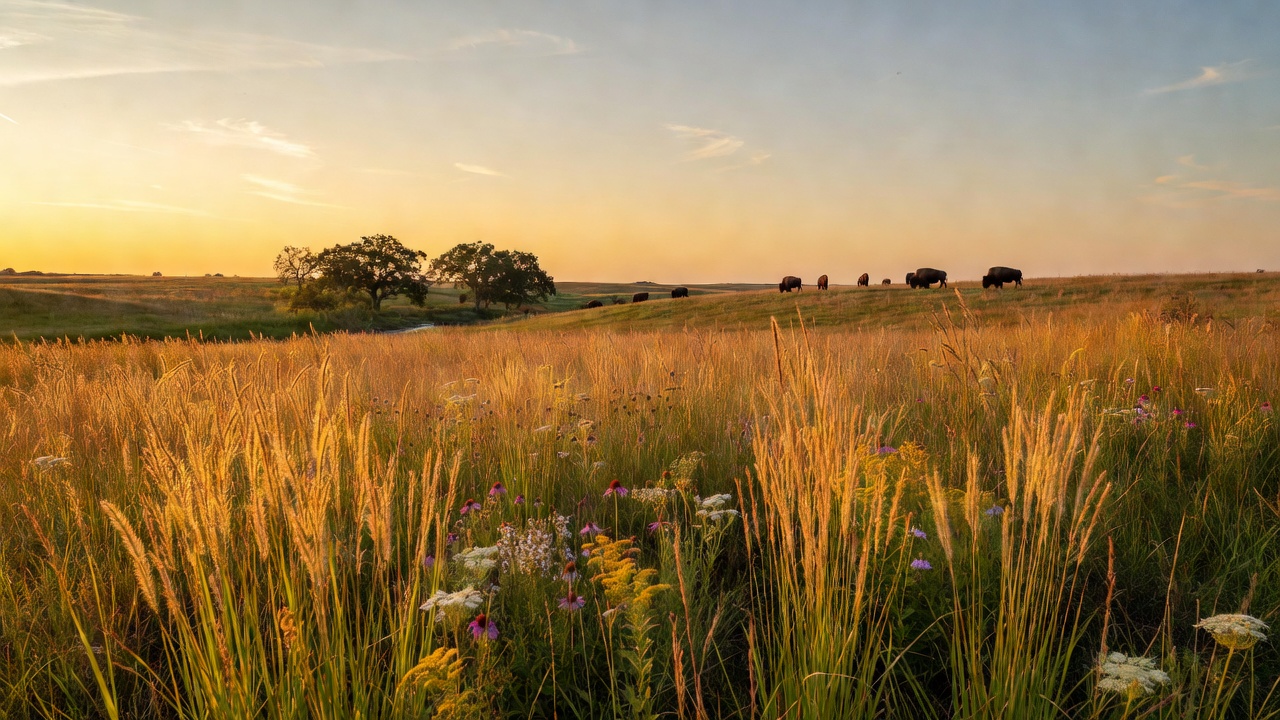
And then there are the bison. In 2015, through a partnership between the Forest Service and the National Forest Foundation, 27 animals -- 23 cows and four bulls -- were released onto a 1,000-acre pasture chosen for its rolling ground, its ability to grow native grasses and forbs, and its lack of leftover infrastructure. They are not scenery. They are the experiment: the question is whether bison grazing, stomping, rolling and wallowing builds a more varied grass structure than cattle do, and whether that variety translates into better habitat for grassland birds. Six animals wear GPS collars, and their range is divided into four treatment areas -- prescribed fire, mowing, herbicide and an untreated control. The herd has since grown enough that animals have been sent on to tribes and educational institutions.
Notable features
The Iron Bridge is the landmark and the best introduction. The trailhead opened in 2007 and the bridge was decked and finished in 2008, carrying foot, bike and horse traffic over Illinois Route 53 and linking the halves of the prairie. Near it stand a statue of an arsenal worker and a preserved World War II bunker -- the clearest single place to stand and read what this ground used to be. Restoration at Iron Bridge Prairie, 47 acres, began in 2009.
For grass, go to the South Patrol Road Prairie Restoration: 500 acres of mixed prairie and wetland reached on foot by the Henslow Trail, with nearly 200 planted species and stretches of eight-foot grass that will change your idea of what 'prairie' means. Late spring through early fall is the window for bloom, and meadowlarks, bobolinks and dickcissels are the soundtrack. Elsewhere on the unit the trail list runs to the Blodgett Marsh Trail at 4.5 miles, Group 63 Interim Trail at 3.6, Bailey Bridge Trail at 2.5, the Prairie Creek Woods Trail and the Hedgeapple Trail, with the Buttonbush Pond Overlook and the Chicago Road Seedbed worth the stop and trailheads at Hoff Road and -- inevitably -- Explosives Road. Named restoration units make good destinations in their own right: Prairie Creek Woods (113 acres, begun 2001) and Middle Grant Creek (463 acres, begun 2007) are two of the big ones.
The bison pasture is the draw for most first-time visitors, and it is fenced -- a six-foot perimeter with five-foot interior dividers -- so this is viewing from outside, not a drive-through. A Welcome Center on Illinois Route 53 sits at the middle of the prairie with displays, maps and trail guides, and there are self-guided tours through a mobile app. Beyond hiking, biking and riding, the Forest Service lists fishing, picnicking, hunting, outdoor science programs and winter cross-country skiing and snowshoeing here.
Two rules to plan around. Horseback riding is on designated multi-use trails only -- roughly 22 miles of them -- and riding hiking-only trails is not permitted. And it bears repeating because it is the one that ruins trips: this is a day-use site, open 4 a.m. to 10 p.m., with no overnight camping. Free camping near here means looking elsewhere; Midewin is a place you visit between camps, not one you sleep in.
Camps are sourced from public U.S. Forest Service recreation data and have not been personally visited. Roads shown are Forest Service passenger-car routes (maintenance level 3–5) and may be seasonal or gated. Always confirm access, fees and fire rules with the ranger district before you go. Found a fee where we show free? Tell us on the contact page.