National Forests in Florida
Where the camps cluster
The place
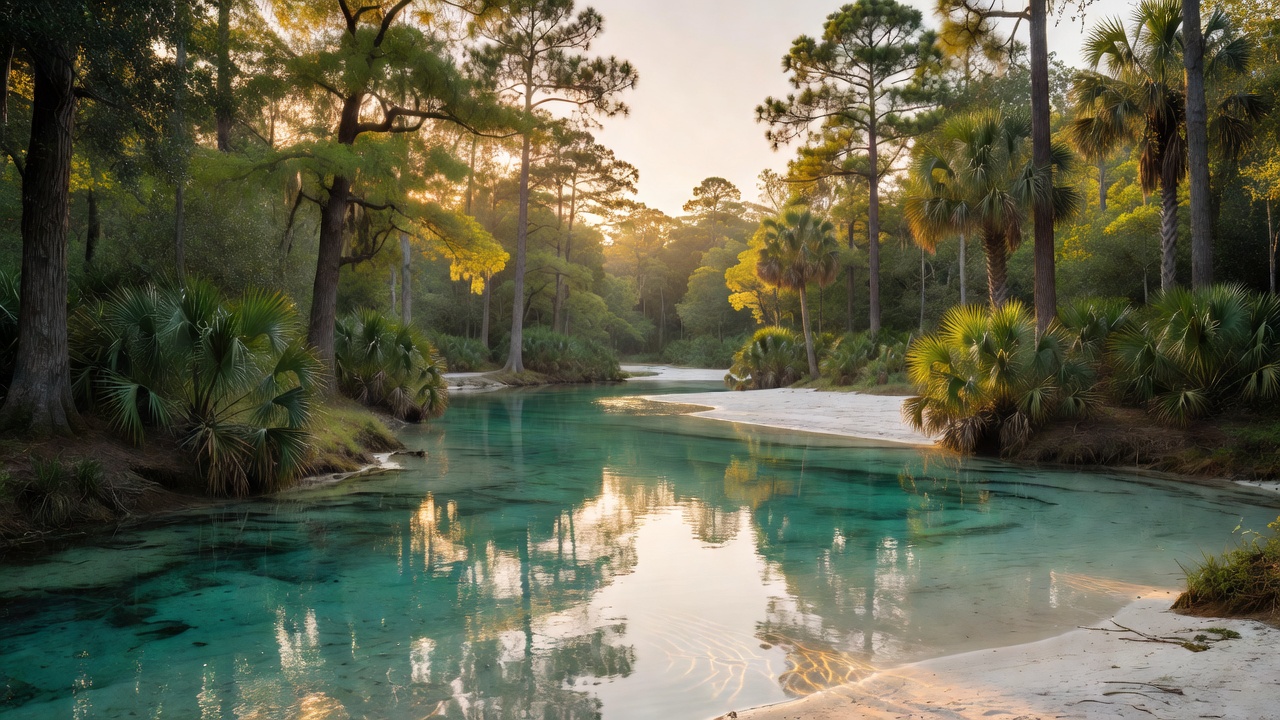
National Forests in Florida is really three forests run as one -- Apalachicola, Ocala, and Osceola -- spread across more than a million acres from the panhandle to the middle of the state. Together they hold some of the wildest ground left in Florida: crystal-clear spring runs that stay near 72F all year, the world's largest contiguous sand pine scrub, longleaf-pine flatwoods, titi swamps, and blackwater rivers. This is working forest, not a national park -- timber, hunting seasons, gators, and black bears -- and the three units feel very different from one another, from Ocala's desert-like scrub and turquoise springs to Apalachicola's wet pine woods and Osceola's cypress swamps reaching north toward the Okefenokee.
History
Each of the three forests has its own start. The Ocala came first, set aside in 1908 under Theodore Roosevelt to protect the 'Big Scrub' -- making it Florida's oldest national forest and the southernmost in the contiguous United States (though, contrary to a line you'll often hear, not quite the oldest national forest east of the Mississippi -- Minnesota's Chippewa was proclaimed months earlier the same year). Osceola followed in 1931 and Apalachicola in 1936, and the three have long been administered together as 'National Forests in Florida,' headquartered in Tallahassee. In the 1930s the Civilian Conservation Corps left its mark, most famously building the stone millhouse-and-waterwheel complex at Juniper Springs. The names carry the region's Native history: Osceola for the Seminole war leader, Ocala thought to come from the Timucua town of Ocali, and Apalachicola from the river and the Indigenous province tied to that drainage.
Wildlife & plants
The Ocala holds one of Florida's largest black bear populations, so proper food storage isn't optional here. In its sun-baked scrub lives the Florida scrub-jay -- a bird found nowhere else on Earth but Florida -- along with the gopher tortoise, whose burrows shelter dozens of other species. The longleaf-pine country, especially in the Apalachicola, is a stronghold for the red-cockaded woodpecker, which nests only in living old pines. Spring runs and rivers bring alligators, wading birds, and -- seasonally, in some of the clear runs like Silver Glen and Salt Springs -- manatees drifting up from the St. Johns. Add white-tailed deer, wild turkey, swallow-tailed kites overhead in summer, and the swampy corners of Osceola stretching toward the Okefenokee's gator-and-crane country.
Notable features
Ocala's springs are the showstoppers: first-magnitude Alexander and Silver Glen, plus the popular second-magnitude Juniper and Salt, all pouring out clear water that holds near 72F year-round. The forest also protects the world's largest contiguous sand pine scrub -- the 'Big Scrub' -- and it's where the Florida National Scenic Trail was born, its first blaze painted in October 1966 (the Florida Trail became a National Scenic Trail in 1983). In the panhandle, the Apalachicola is the largest of the three at roughly 570,000 acres, home to the wet, tough Bradwell Bay Wilderness. Up north, Osceola wraps around Olustee Battlefield -- site of the largest Civil War battle fought in Florida (1864), now a state historic park -- and its Pinhook Swamp forms a wildlife corridor reaching toward Georgia's Okefenokee Swamp.
Camps are sourced from public U.S. Forest Service recreation data and have not been personally visited. Roads shown are Forest Service passenger-car routes (maintenance level 3–5) and may be seasonal or gated. Always confirm access, fees and fire rules with the ranger district before you go. Found a fee where we show free? Tell us on the contact page.