Moochdocking
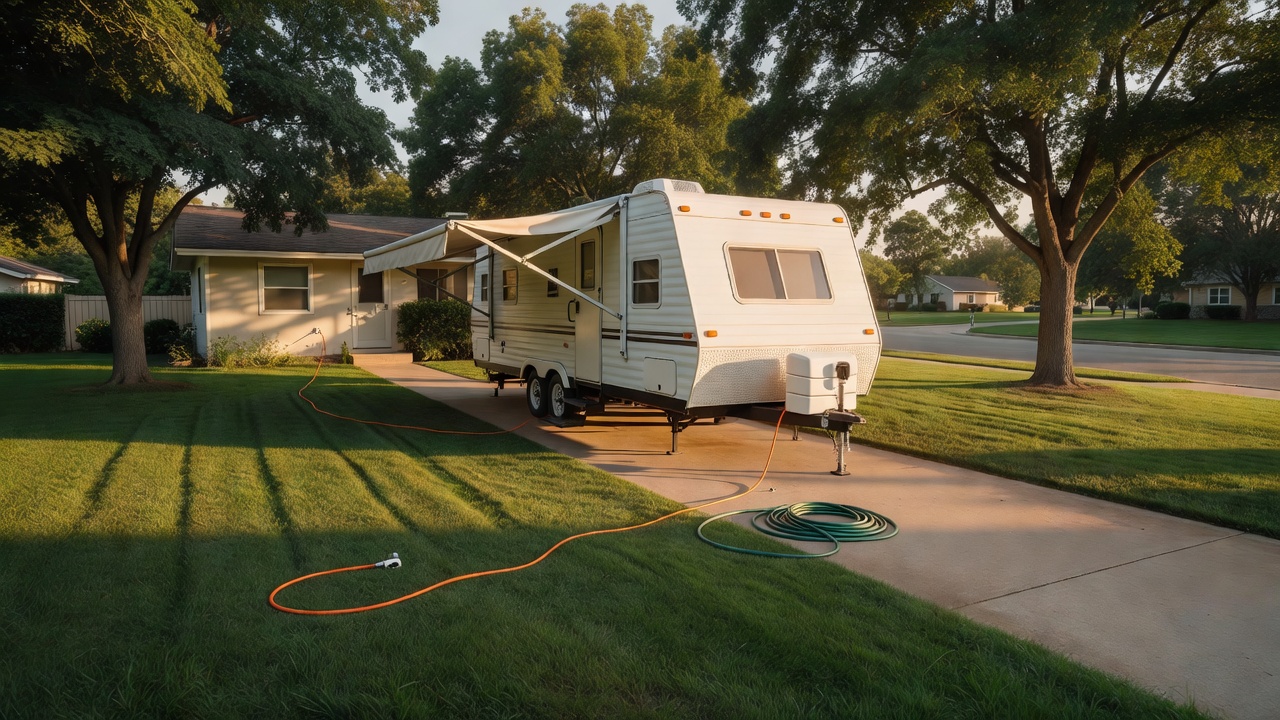
Moochdocking is parking your rig on somebody's private property instead of paying for a site -- a friend's driveway, your sister's side yard, a buddy's back pasture -- usually free, usually with a cord run out to the house for power. The name is a joke about mooching, and it's the only part that's simple: the catch isn't your host, it's the town, because plenty of jurisdictions cap how many nights an RV may be slept in on residential property and some prohibit it outright.
In the field
Take "mooch" and bolt it onto "boondocking" and you have the word. The distinction that matters is that boondocking is self-contained by necessity -- you're out on public land with whatever you brought -- while moochdocking has a house forty feet away. In practice that usually means an extension cord, a hose bib, wifi, a real shower, and a laundry machine you didn't have to feed quarters. It is the cheapest, warmest, most convenient night in RVing, which is exactly why nobody thinks to check whether it's legal.
It usually is legal to be there. Wikipedia's plain summary is a good starting posture: "While it is legal in all of the United States to live in an RV, there are laws regarding where and for how long RVs can be parked." Here's the part people miss -- because you're on private residential land, the agency writing the rule isn't the Forest Service or the BLM. It's a city or a county, the rule lives in a zoning code, and it varies wildly from one side of a county line to the other.
How wildly? Five real examples, all published by the jurisdiction itself. Los Angeles County's Department of Public Health states flatly that "Generally, Recreational Vehicles (RVs), campers and trailers are not allowed to be used on a property for living or sleeping overnight." Rancho Palos Verdes, California says "Parked or stored vehicles may not be occupied or used for sleeping," then adds the useful half of the sentence: "However, temporary guest permits may be obtained from the city." Walton County, Florida permits an RV as a temporary residence "only by the property owner, and only during construction of a primary residence on the same site" -- which is to say, the visiting-guest case simply isn't provided for. The City of Burton, Texas describes moochdocking almost by name and allows it: an RV used for sleeping may be parked on a resident's property "when the owner of the RV is visiting the occupant of the residence for a period of less than 30 (thirty) days" -- with a permit from City Hall within 48 hours of set-up. And Snohomish County, Washington is downright generous: a guest's RV "can be occupied for up to 180 days in any 12-month period," with "One recreational vehicle ... used as temporary living quarters per lot."
Zero nights, seven-ish, thirty, a hundred and eighty. That's the whole lesson: there is no national moochdocking rule to look up, and the five above are examples of the spread, not a survey. Note also how Snohomish ends its bulletin -- it "only applies to property within unincorporated Snohomish County and does not apply to property within incorporated city limits." County and city are different rulebooks, and your host's mailing address will not tell you which one you're under. One phone call to the local planning or code-enforcement office answers it in five minutes. Ask about the HOA too, if there is one; that's a separate rulebook again.
Then there's the plumbing, which is where a free night turns expensive. Do not get creative with your tanks. LA County lists what legal disposal actually looks like -- a permitted plumbing connection to the sewer, an existing septic system that a qualified contractor has evaluated, a licensed on-site pumping service, or an RV dump station -- and rules out the shortcut everybody tries first: "Connecting to an existing clean-out access is not permitted." Burton's ordinance is blunter: "Under no circumstances shall sewer connections be made with a recreational vehicle located outside of an RV Park. The dumping of waste from recreational vehicles on public or private land, except at a designated RV dump, is expressly prohibited." And the reason isn't bureaucratic fussiness -- dumping "onto the ground surface or directly into a storm drain" can, in the county's words, "contaminate surface water, groundwater, attract vermin, or spread disease." (That LA County guidance is written for a specific temporary-housing program, not for weekend guests, but it's a clear picture of what a health department considers acceptable.)
If your host is on a septic system, be genuinely careful, because you are a second household arriving on a drainfield sized for one. LA County requires that such a system be evaluated to confirm it "has the capacity for the additional wastewater load from the RV," and the EPA explains the failure mode plainly: "If the drainfield is overloaded with too much liquid, it can flood, causing sewage to flow to the ground surface or create backups in toilets and sinks." Nothing ends a family visit faster than backing sewage up into your mother-in-law's bathroom.
One small thing that surprises people: the hose. LA County's guidance warns that "Garden hoses are not rated for potable water and can leech chemicals into your RV water supply that may affect the taste, smell, and safety of your water. Only food-safe hoses should be utilized." Carry your own white drinking-water hose and use the host's spigot with it. Simply connecting to an existing hose bib is the easy case -- LA County notes those connections "do not require approval" -- while plumbing in a new line or bib is where permits start.
The rest is manners, and manners are the actual price of admission. You are not on a campsite; you're in someone's front yard, in view of neighbors who didn't invite you. Pay the power bill or hand over cash without being asked, keep the awning and the outdoor rug from turning the driveway into a permanent installation, respect the street's bedtime, and leave a couple of days before anyone starts wishing you would. The complaint that triggers enforcement almost never comes from your host -- it comes from three doors down. (American Adventurer maps legal dispersed spots on public land; a driveway isn't one of them, which is the nice thing about a friend with a driveway.)
See also
Put it to use
Sources
- Los Angeles County Department of Public Health, Environmental Health -- Recreational Vehicles (RVs): Temporary Use for Housing. "Generally, Recreational Vehicles (RVs), campers and trailers are not allowed to be used on a property for living or sleeping overnight."; "Garden hoses are not rated for potable water and can leech chemicals into your RV water supply that may affect the taste, smell, and safety of your water. Only food-safe hoses should be utilized."; "Connections from an existing water supply hose bib to the RV do not require approval."; on using the sewer: "Connecting to an existing clean-out access is not permitted."; on septic: "you must have your system evaluated by a qualified contractor to verify that the system is in good condition and has the capacity for the additional wastewater load from the RV"; "Disposal of RV wastewater in an unapproved method, such as onto the ground surface or directly into a storm drain, may contaminate surface water, groundwater, attract vermin, or spread disease."
- City of Rancho Palos Verdes, CA -- RV Parking Regulations (Code Enforcement): "Parked or stored vehicles may not be occupied or used for sleeping. However, temporary guest permits may be obtained from the city."
- Walton County, FL Planning Department FAQ -- "Can I live in my Recreational Vehicle (RV)?": "The use of a recreational vehicle as a permanent residence is not permitted, except within duly licensed and permitted recreational vehicle campgrounds/parks"; recreational vehicles "may be used as temporary residences in zoning districts allowing residential uses as a primary use, only by the property owner, and only during construction of a primary residence on the same site."
- Snohomish County, WA Planning and Development Services -- Assistance Bulletin #53, Recreational Vehicles (revised January 2025): "When a recreational vehicle is used as temporary living quarters by a guest(s) of the legally occupied dwelling out of the floodway, it is no longer an incidental use. When the RV is no longer an incidental use, it can be occupied for up to 180 days in any 12-month period within the zone listed above. One recreational vehicle can be used as temporary living quarters per lot."; "This Assistance Bulletin only applies to property within unincorporated Snohomish County and does not apply to property within incorporated city limits."
- City of Burton, TX -- Ordinance No. 201809108, regulating the parking, storage and use of recreational vehicles. Section 3: an RV used for sleeping may be parked on a permanent resident's property "when the owner of the RV is visiting the occupant of the residence for a period of less than 30 (thirty) days", with an RV Permit obtained from the City Secretary "within 48 hours of set-up"; "Under no circumstances shall sewer connections be made with a recreational vehicle located outside of an RV Park. The dumping of waste from recreational vehicles on public or private land, except at a designated RV dump, is expressly prohibited."
- U.S. Environmental Protection Agency -- How Your Septic System Works: "A typical septic system consists of a septic tank and a drainfield (or soil absorption field)."; "If the drainfield is overloaded with too much liquid, it can flood, causing sewage to flow to the ground surface or create backups in toilets and sinks."
- Recreational vehicle (Wikipedia) -- "While it is legal in all of the United States to live in an RV, there are laws regarding where and for how long RVs can be parked."