Dump station
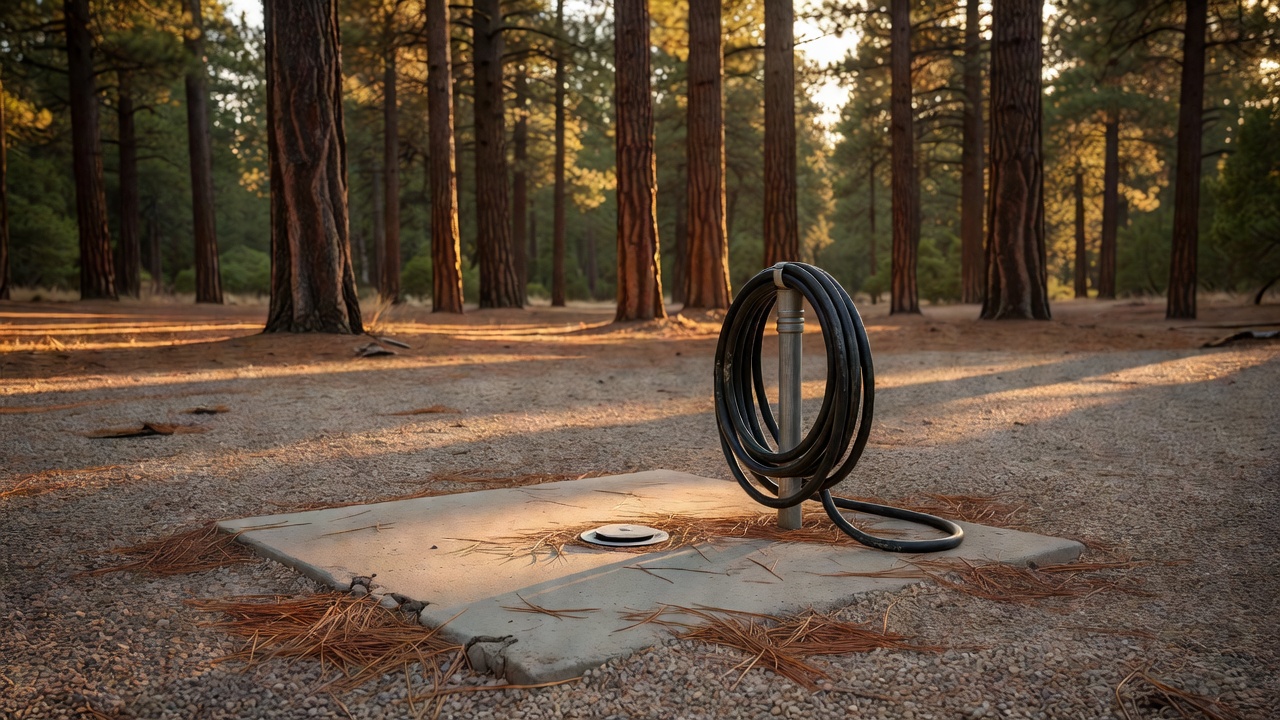
A dump station is a legal, plumbed place to empty an RV's holding tanks -- usually a concrete pad with a capped sewer inlet flush in the ground and a rinse hose beside it. Black water (the toilet) and gray water (the sinks and shower) both go down that same hole, and on national forest land putting either one on the ground instead isn't a gray area, it's a prohibited act.
In the field
For your trip, the tanks are the real clock -- they fill whether or not you're anywhere near a road, and the dump station is the only thing that resets them. What it costs depends on who runs it and whether you're already a paying camper. Zion National Park charges non-campers $5 for "a single use of the water fill and sanitary dump station"; Quartz Flat Campground on the Lolo National Forest lists a "$10 dumping fee if users are not staying overnight." Camp there and it's typically folded into your site fee. There is no national price and no national policy -- every unit sets its own.
Here's the first catch: the thing is plumbed, so it lives and dies by the water season. Quartz Flat's station is listed open May 21 through September 8 for 2026, and Theodore Roosevelt National Park's two -- one at Juniper Campground, one in the town of Medora -- are listed as open "approx. May - Sept." Capitol Reef adds the other flavor: its station "may be closed periodically for maintenance." A pin on a map is not an open valve. Shoulder-season and winter trips should assume the nearest one is drained and locked until the managing office says otherwise.
Second catch, the one that catches boondockers: dispersed camping doesn't come with a dump station, or a vault toilet, or anything else. The Forest Service sanitation rule (36 CFR 261.11) is blunt about where the waste goes -- it prohibits "placing in or near a stream, lake, or other water any substance which does or may pollute," and prohibits failing to dispose of garbage "including any paper, can, bottle, sewage, waste water or material" either by removing it from the area or putting it into a receptacle provided for that purpose. Note the words waste water: gray water is not a loophole. Capitol Reef requires that "water from dishwashing, bathing, and solar showers must be collected and deposited in gray-water disposal sinks," and Theodore Roosevelt says flatly that "dumping of any waste on the ground is prohibited" and that RVs "must dispose of waste water by using either a holding tank or a catch bucket." The exact local wording varies by forest, park and state -- read the rules for the unit you're actually in.
Finding one on a route is less solved than you'd hope. There's no single federal directory; dump stations turn up as an amenity line on individual campground pages at fs.usda.gov and nps.gov, which means you find them one campground at a time. Highway rest areas used to be the reliable fallback and increasingly aren't -- Iowa's DOT states "We no longer offer RV dump stations at Iowa Rest Areas," and Utah's says "There are no RV hookups, RV dumps or camping facilities at any Rest Area site," pointing instead at third-party lists it explicitly doesn't guarantee. So plan the dump the way you plan fuel: pick the stop before you leave pavement, and know your backup. And if you want drinking water while you're there, take it from a spigot that's actually labeled potable -- the hose at the dump pad is there to rinse a sewer fitting.
Last one, and almost nobody knows it: what you put in the tank matters to the place you empty it. EPA's Region 9 alert for RV owners names formaldehyde and para-dichlorobenzene -- common ingredients in holding-tank deodorizers -- as chemicals that kill the bacteria an onsite septic system runs on, and warns that operators whose systems cause contamination "may be forced to close the dump station or the park until the problem can be corrected." The same sheet's plainest advice is the one worth repeating: use toilets for waste and toilet paper only. The wipes, the cat litter and the miracle blue chemical are how a station on next year's route becomes a station that's closed.
See also
Put it to use
Sources
- GovInfo -- 36 CFR 261.11, Sanitation (Forest Service prohibited acts: polluting water; failing to dispose of sewage/waste water properly)
- USDA Forest Service -- Quartz Flat Campground, Lolo National Forest ($10 dump fee for non-overnight users; seasonal dates)
- Recreation.gov -- Watchman Dump Station Fee for Non-Campers, Zion National Park ($5 single use of water fill + sanitary dump station)
- National Park Service -- Theodore Roosevelt NP Camping Regulations (holding tank or catch bucket; no dumping on the ground; seasonal stations)
- National Park Service -- Capitol Reef NP Campground Regulations (gray-water disposal sinks; dump station closed periodically for maintenance)
- Iowa DOT -- Rest Areas ("We no longer offer RV dump stations at Iowa Rest Areas")
- Utah DOT -- Rest Areas (no RV dumps at any Utah rest area site)
- EPA Region 9 -- Alert for RV, Boat and Mobile Home Owners and Park Operators About Safe Wastewater Disposal (EPA 909-F-99-002)