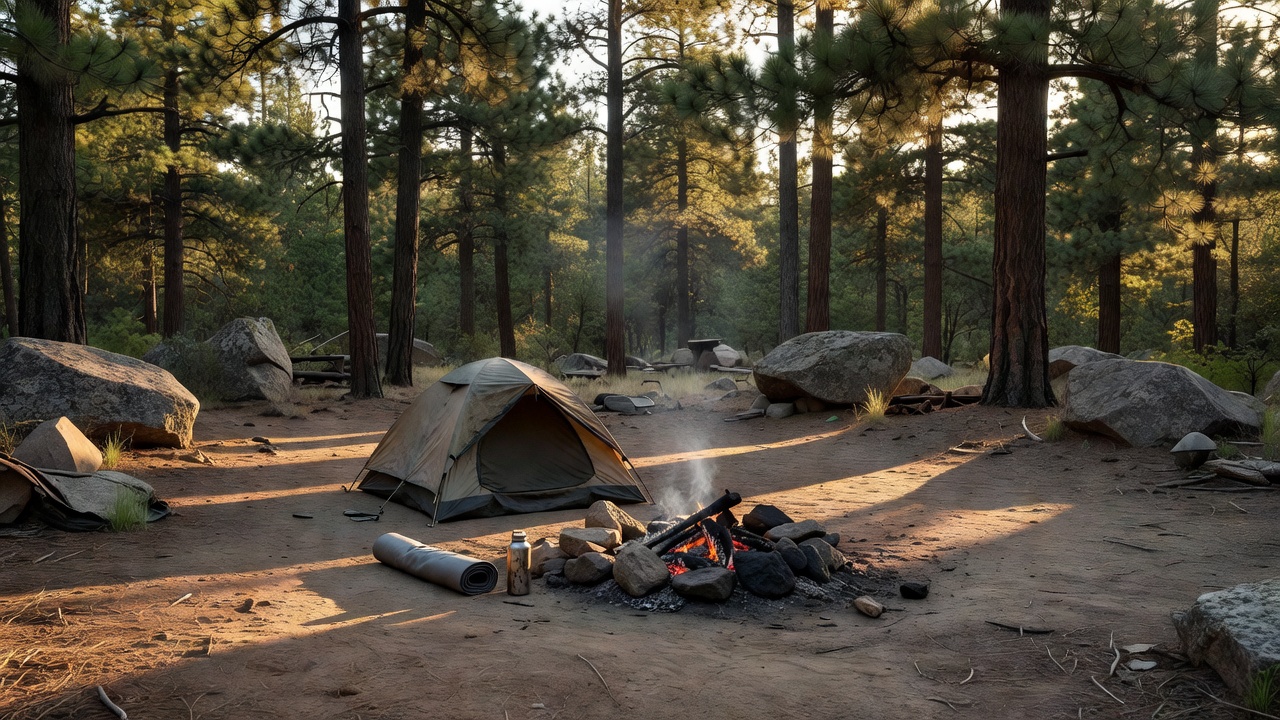
Primitive camping
Primitive camping is camping stripped to the studs — no electricity, no running water, no flush toilet, maybe a fire ring and a vault toilet if you're lucky. You pack in what you need and pack out what's left. That's the whole deal.
In the field
It's a spectrum, not a single rule. At one end is a primitive campground — a designated, often numbered site the agency set aside, but with next to nothing: maybe a cleared spot, a fire ring, and a vault toilet down the road, no electricity or running water. At the other end it blurs into dispersed and backcountry camping, where you leave developed campgrounds behind entirely and there's nothing at all.
What ties them together is what you don't get. The Forest Service calls the primitive end 'minimal site amenities' and, out in the general forest, 'no services (such as trash removal) and few or no facilities (such as tables and fire pits).' Its own guidance is blunt: 'No amenities are provided; such as water, restrooms or trash cans. Be self-contained.' The Park Service frames its backcountry version the same way — you head 'past the campground and lot attendant' and bring your own everything.
Being self-contained is the whole job. Carry your own drinking water or the means to treat it, a way to cook, and a plan for waste. Pack out all your trash, bury human waste well away from water, and follow Leave No Trace so the next camper finds the spot as clean as you did. A campfire permit or a seasonal fire restriction often applies, so check the local ranger district before you strike a match.
Primitive sites come with stay limits too. On the Daniel Boone National Forest, for instance, you 'may only camp for a consecutive 14 days or less in a 30-day period' — a 14-day cap is common, but the exact window varies by forest or field office, so read the posted rules. The payoff for all that self-reliance is quiet and solitude you'll never find in a full-hookup loop. e.g. a numbered primitive site a mile down a gravel spur — a fire ring, a vault toilet, and nobody else in earshot. We note what is and isn't there on the sites we map, but the managing agency's own page always has the final word.
See also
Put it to use
Sources
- US Forest Service -- George Washington & Jefferson NF, Camping & Cabins: developed vs primitive campgrounds; dispersed = no amenities, be self-contained
- US Forest Service -- Daniel Boone NF, Camping & Cabins: dispersed = no services/few facilities; 14 days in a 30-day period
- National Park Service -- Backcountry Camping: very limited amenities, permits, Leave No Trace