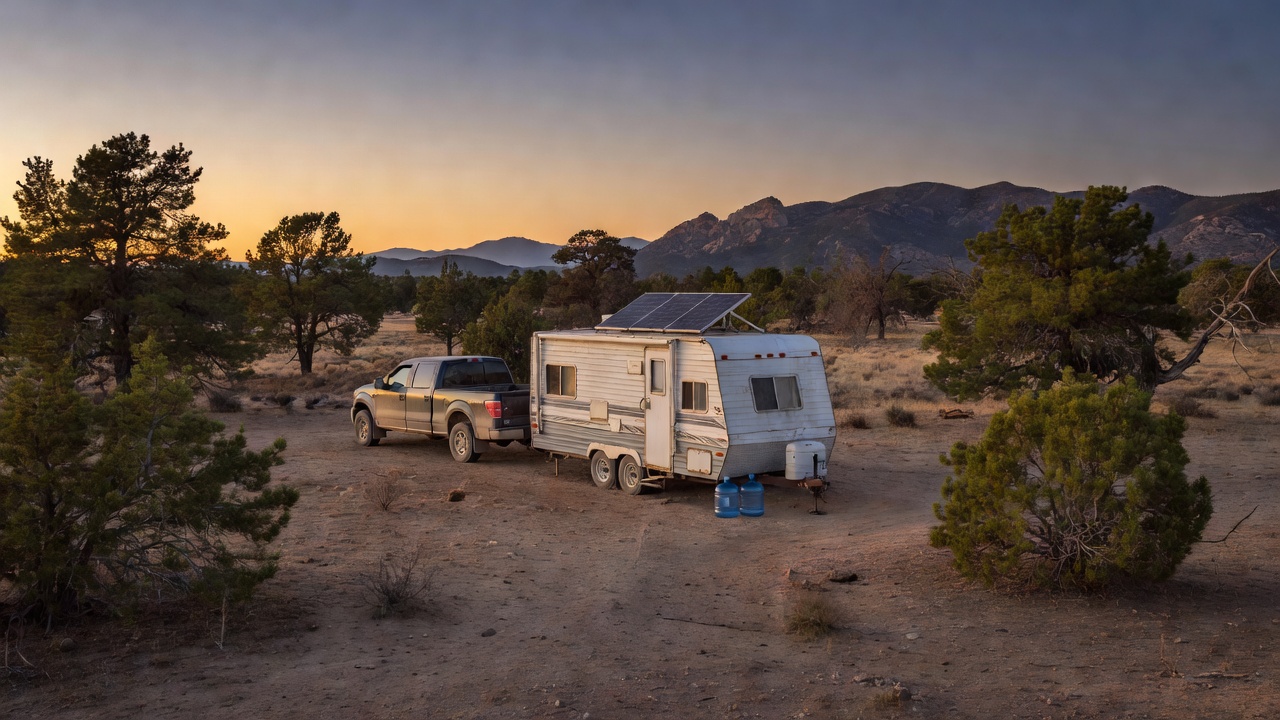
Dry camping
Dry camping means there's nothing to plug into at your site — no electric, no water, no sewer — so you run entirely off what you brought. Could be deep in a forest or a store parking lot; 'dry' is about the missing hookups, not the location.
In the field
You live off your own fresh-water tank, batteries or solar, propane, and your rig's holding tanks for waste. Federal campgrounds say it plainly: Grand Canyon's Mather Campground states it has no electric, water, or sewer connections at individual sites, and the tent and group sites at Pinnacles National Park have no hookups of any kind.
Campers split hairs between 'dry camping' and 'boondocking,' and here's the honest line: dry camping is the broader word — it just means no hookups, so it covers a no-hookup site inside a developed campground, an overnight in a parking lot, or a night in a friend's driveway. Boondocking is dry camping out on undeveloped public land. All boondocking is dry camping; not all dry camping is boondocking.
'Dry' doesn't mean you rough it completely, either. Plenty of dry campgrounds still hand you shared amenities — just not a connection at your own site. Mather has drinking-water spigots throughout and a free dump station nearby even though no site has hookups; vault or flush toilets, picnic tables, and fire rings are common. You simply can't plug in where you park.
Because you're self-contained, the planning is on you: enough water, enough power, and a plan for waste. And generators are often reined in to keep the peace — Mather allows them only 7:00–9:00 a.m. and 6:00–8:00 p.m., while Pinnacles bans them at any site entirely — so check before you count on one. e.g. a no-hookup forest loop where you top off at a shared spigot on the way in and empty your tanks at the dump station on the way out. A site with all three connections is called full hookups; only some is partial. We note which camps are dry versus hookup where we can, but the campground's own page always has the final word.