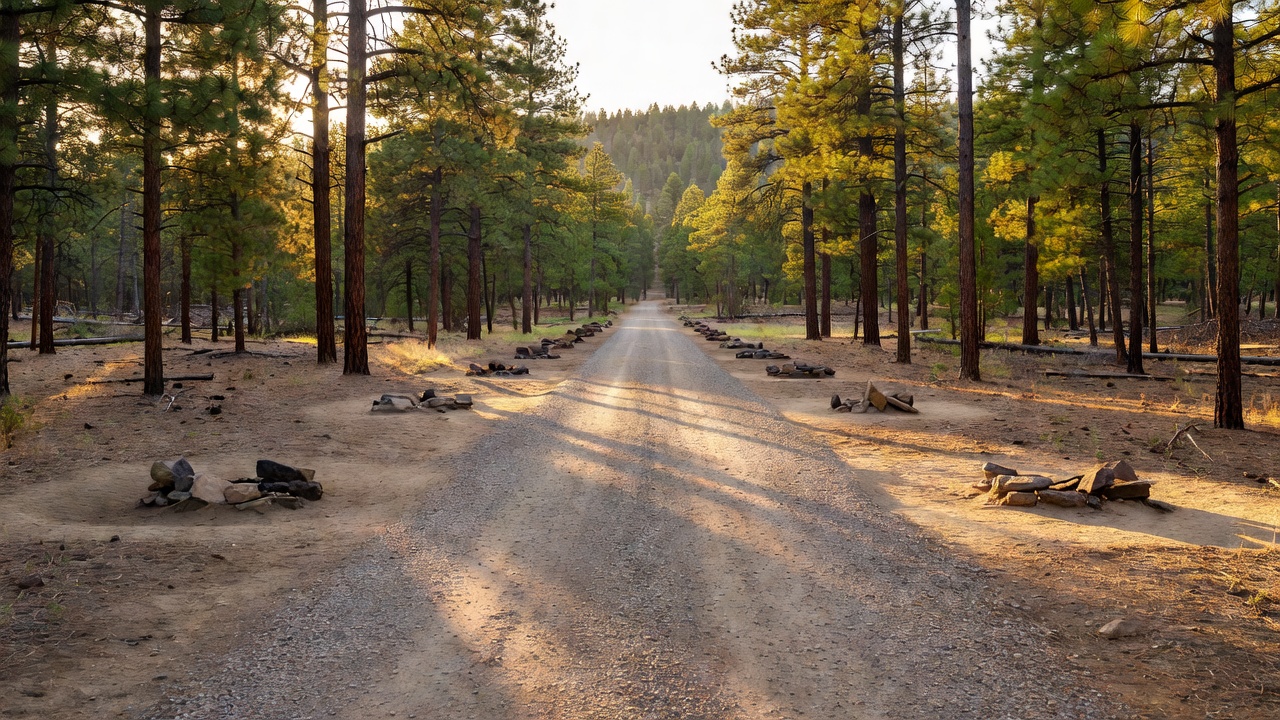
Dispersed Camping Corridor
A dispersed camping corridor is a ribbon of legal camping running alongside a forest road -- on the forests that use them, you may pull off and camp only within a set distance of the roads that carry the camping symbol on the Motor Vehicle Use Map (commonly up to 300 feet), and nowhere else.
In the field
The corridor exists because of one sentence of federal rule. Under 36 CFR 212.51(b), when a forest decides which routes are open to motor vehicles, the responsible official "may include in the designation the limited use of motor vehicles within a specified distance of certain forest roads or trails where motor vehicle use is allowed... solely for the purposes of dispersed camping or retrieval of a downed big game animal." Read that again and notice what it doesn't say: it never names a distance, and it says certain roads, not all of them. Everything else about corridors is a local decision printed on the Motor Vehicle Use Map. The Black Hills National Forest puts the consequence bluntly: "You may camp with a motor vehicle only where the dispersed camping symbol is displayed on the MVUM." The Willamette says the same thing the other way around -- motorized dispersed camping "may occur only in those areas indicated on the MVUM."
What this changes about your trip: on a corridor forest you stop hunting for campsites and start hunting for roads. Open the MVUM, find which routes carry the camping symbol and what distance the legend gives them, and plan your night around those roads -- because a gorgeous flat meadow a mile up an uncorridored road is simply not available to you, no matter how empty it looks. The flip side is that this is not a stingy amount of country: the Black Hills alone counts roughly 135,500 acres open to motor-vehicle dispersed camping. It's a lot of land, shaped like a road network instead of a blob.
Here's the catch, and it's the one that costs people a ticket: the distance is usually measured from the CENTERLINE, not from where your tires leave the gravel. The Rio Grande National Forest says "All vehicles must stay within 300 feet of the center line of a designated road," and the Coronado says vehicles "must remain within 300 feet from the centerline of the road." You lose half a road width off the top. Two more traps in the same family. First, a corridor is permission to reach a campsite, not permission to build one -- the Willamette's allowance is to "access and use established dispersed campsites," and the Black Hills adds flatly that "Resource damage is not allowed as a result of dispersed camping." Second, corridors get switched off road by road: the Rio Grande names specific roads (250, 360, 410) where dispersed camping is banned outright even though the general 300-foot rule applies elsewhere on the forest.
And the biggest catch of all -- plenty of forests don't do corridors at all, so the concept doesn't travel. On the Six Rivers National Forest there's no 300-foot band; motor vehicle designations include only "parking one car length along the designated routes," and otherwise "visitors cannot drive off of designated roads and trails." Swing the other way and the Helena-Lewis and Clark says dispersed camping is "generally allowed anywhere except where posted closed" -- no corridor needed. Same agency, three completely different answers. Stay limits move too: 14 days in any 30-day period on the Rio Grande, 14 days per 60-day period on the Coronado. So never carry one forest's corridor rule across a boundary. Pull the MVUM for the specific forest you're standing on and read its legend -- that's where the distance, the symbol, and the season actually live. American Adventurer notes which forests run corridor systems so you know before you turn off the highway whether you're picking a patch or picking a road.
See also
Put it to use
Sources
- 36 CFR 212.51 -- Designation of roads, trails, and areas for motor vehicle use; para. (b) authorizes "limited use of motor vehicles within a specified distance of certain forest roads or trails... solely for the purposes of dispersed camping or retrieval of a downed big game animal" (no distance is specified in the rule)
- Forest Service (Black Hills NF) -- MVUM FAQs: "You may camp with a motor vehicle only where the dispersed camping symbol is displayed on the MVUM"; "up to 300 feet from certain designated roads"; ~135,500 acres; "Resource damage is not allowed as a result of dispersed camping"
- Forest Service (Willamette NF) -- Motor Vehicle Use Map: motorized dispersed camping "may occur only in those areas indicated on the MVUM"; "motor vehicles may travel up to 300 feet off of the road to access and use established dispersed campsites"
- Forest Service (Rio Grande NF) -- Dispersed Camping: "All vehicles must stay within 300 feet of the center line of a designated road"; "Camping is limited to 14 days in any 30 day period"; named roads (250, 360, 410) where dispersed camping is not allowed
- Forest Service (Coronado NF) -- Dispersed Camping: "Download a Motor Vehicle Use Map to see motor vehicle routes and dispersed camping corridors"; "vehicles must remain within 300 feet from the centerline of the road"; "14-day stay limit per 60-day period"
- Forest Service (Six Rivers NF) -- Motor Vehicle Use Maps: designations include "parking one car length along the designated routes"; "visitors cannot drive off of designated roads and trails, except where specifically allowed"
- Forest Service (Helena-Lewis and Clark NF) -- Dispersed Camping: "Dispersed camping is generally allowed anywhere except where posted closed, where overnight parking is prohibited, or within 200 feet of developed road, trail or facility"