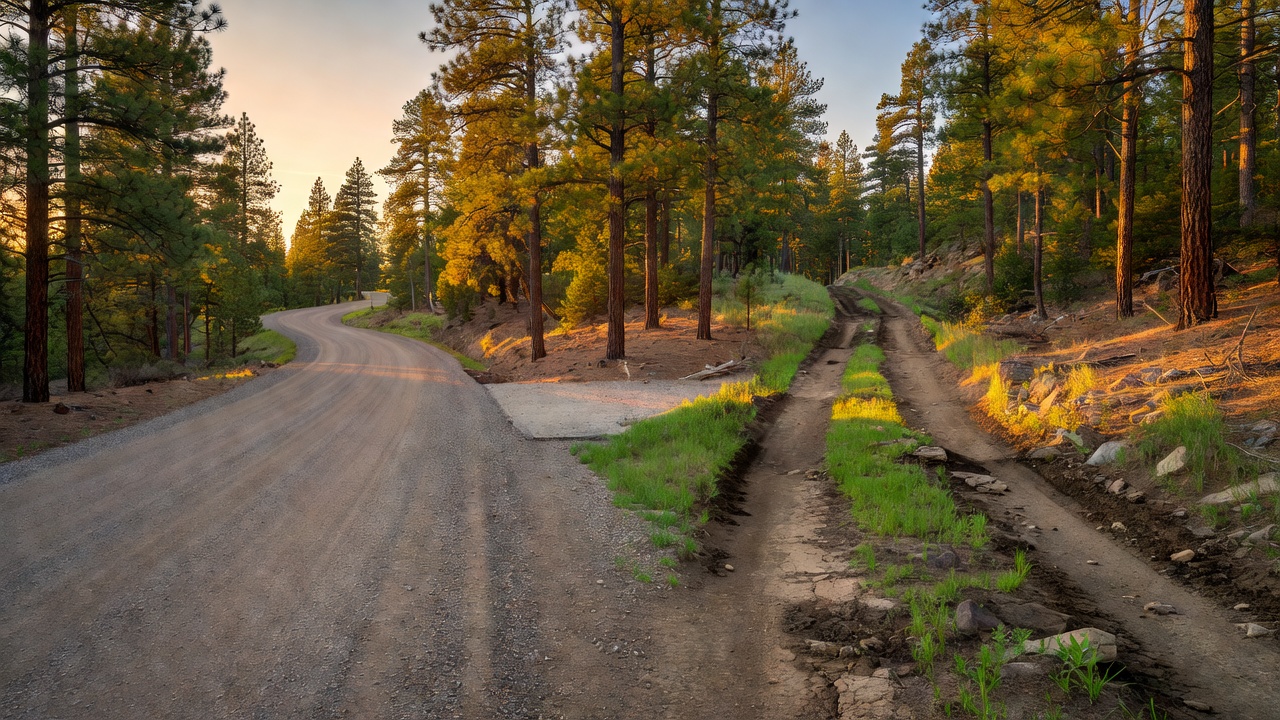
road maintenance level (ML1-ML5)
A road maintenance level is the Forest Service's 1-to-5 rating of how much road a given forest road is meant to be -- 5 is a paved two-laner, 3 is a gravel road kept passable for a careful driver in an ordinary passenger car, 2 is high-clearance country where nobody even puts up warning signs, and 1 is a road in storage that's closed to vehicles -- and it describes the service the road is budgeted to provide, not the condition you'll find on it today.
In the field
The scale runs downhill from pavement, and the Forest Service's own handbook (FSH 7709.59, ch. 60) says what each rung means. Level 5 roads "provide a high degree of user comfort and convenience" and are "normally double lane, paved facilities." Level 4 gives "a moderate degree of user comfort and convenience at moderate travel speeds" -- mostly double lane and gravel, sometimes paved. Level 3 is the honest workhorse of the system: "open and maintained for travel by a prudent driver in a standard passenger car," typically low speed, single lane with turnouts, and comfort is explicitly "not considered" a priority. Level 2 is "assigned to roads open for use by high clearance vehicles," where "passenger car traffic, user comfort, and user convenience are not considerations." Level 1 is a road put in storage for more than a year -- it gets just enough custodial maintenance to keep the drainage from failing, it's closed to vehicular traffic, and it isn't shown on the MVUM at all.
For your trip, the whole decision lives at the line between 3 and 2. A level 3 road is the one you can take the family sedan down in dry weather without a story to tell afterward; signs are posted to MUTCD standards, so hazards that "may violate expectations" get flagged. A level 2 road is a different animal, and the handbook is refreshingly blunt about it: warning signs and traffic control devices "are not provided" beyond the odd sign at an intersection, and "motorists should have no expectations of being alerted to potential hazards while driving these roads." Nobody is going to warn you about the washout past the next bend. Level 2 is also, by the handbook's own description, where dispersed recreation traffic normally lives -- which is exactly why the good quiet camping tends to be down there, and exactly why clearance and a spare matter more than horsepower.
The number isn't folklore -- it's a field in the Forest Service's national road data, OPERATIONALMAINTLEVEL, defined as "the maintenance level currently assigned to the road considering current needs, road condition, budget constraints and environmental concerns." That's the field American Adventurer filters on: the roads drawn on our forest maps are levels 3 through 5, the passenger-car-and-better tier, because those are the ones we can honestly draw without implying your Camry will make it. Note that the level answers a different question than the MVUM does: the MVUM says what you may legally drive, the maintenance level says what the road is kept up to be. A route can be perfectly legal and still be a rutted mess.
Here's the catch, and it's the one that strands people. The maintenance level is an intention, not an inspection. There are two of them on the books -- the operational level (how it's being maintained now) and the objective level (how it's meant to be maintained someday), and the handbook notes the objective "may be the same as, or higher or lower than" the operational level. When money is short, the same handbook tells forests they may "defer work, reduce maintenance frequencies, close roads, or allow roads to deteriorate." The Forest Service says the quiet part out loud on its own visitor map page: designation "should not be interpreted as ... an implication that the road, trail, or area is passable, actively maintained, or safe for travel," and maintenance "will depend on available resources, and many may receive little maintenance." The Black Hills National Forest puts it the same way -- open to a class of vehicle doesn't mean maintained for or suitable for it. Add weather on top: levels say nothing about season, and practice varies by forest -- Mt. Hood, for one, tells visitors its forest roads aren't plowed or maintained for winter travel and that most, though not all, of its seasonal closures run December 1 through March 31. Treat the level as the ceiling on what to expect, call the ranger district for the floor, and remember that one wet week can turn a level 3 into a recovery drill.
See also
Put it to use
Sources
- U.S. Forest Service -- FSH 7709.59, Road System Operations and Maintenance Handbook, ch. 60 (Road Maintenance), secs. 62.3-62.32
- U.S. Forest Service -- National Forest System Roads (MVUM) geospatial metadata, OPERATIONALMAINTLEVEL attribute and coded values
- U.S. Forest Service -- About the Forest Service Visitor Map (designation and maintenance disclaimer)
- U.S. Forest Service -- Black Hills National Forest, MVUM FAQs
- U.S. Forest Service -- Mt. Hood National Forest, National Forest Roads (seasonal closures, winter travel)