Overlanding
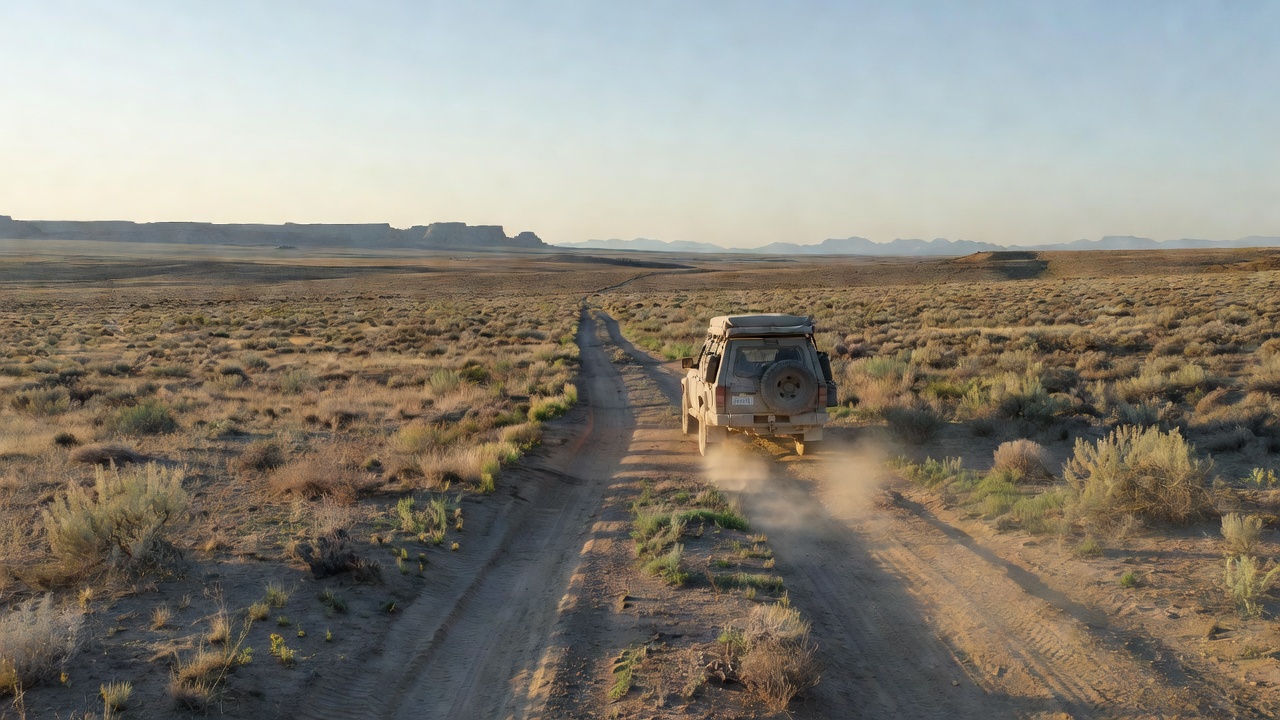
Overlanding is self-reliant vehicle travel where the driving is the point -- you carry your own water, fuel, food and bed, take the dirt route toward somewhere remote, and camp wherever the day ends. The textbook version is "self-reliant overland travel to remote destinations where the journey is the principal goal"; the practical version is that if you're in a hurry to arrive, you're doing some other hobby.
In the field
The cleanest definition going calls overlanding "self-reliant overland travel to remote destinations where the journey is the principal goal," and adds that it is "typically, but not exclusively, accomplished with mechanized off-road capable transport (from bicycles to trucks) where the principal form of lodging is camping." Read that parenthetical twice, because it does more work than any gear review you will ever see: bicycles to trucks. The vehicle is not what makes it overlanding. Distance, self-sufficiency and sleeping outside are what make it overlanding.
That's also the honest line between overlanding and off-roading, which get used interchangeably and shouldn't be. Off-roading is about the obstacle -- the rock garden, the hill climb, the mud pit -- and a great day of it can end fifty feet from where it started. Overlanding is about the distance between obstacles. The hard section is a toll you pay to get somewhere, not the reason you came, and the measure of a good trip is how far you got and how little you needed from anybody. Plenty of famous overland routes barely require four-wheel drive at all; they require that you can go several days without a gas station.
The word is much older than the marketing. "Overlanding" is originally an Australian term for droving livestock over very long distances "to open up new country or to take livestock to market far from grazing grounds" -- it described a job, not a weekend. Alfred Canning opened the Canning Stock Route between 1906 and 1910 for exactly that. The recreational version grew out of some genuinely absurd trips: the Cairo-to-Cape-Town route runs "more than 10,000 km (6,200 miles)"; the 1955-6 Oxford and Cambridge Far Eastern Expedition drove from London to Singapore; in 1954 Helen and Frank Schreider drove and sailed the length of the Americas, from Circle, Alaska on the Arctic Circle to Ushuaia in Tierra del Fuego. Then the hippie trail ran from Europe to Nepal and on to Goa and Southeast Asia through the 1960s and 70s, and as the source dryly puts it, "often people were travelling with old buses and VW vans, a real adventure indeed." The modern boom owes a lot to the Camel Trophy, run from 1980 to 2000. The through-line worth noticing: essentially all of that was done in vehicles less capable than what's in your driveway.
Now the catch, and in the States it's a legal one rather than a mechanical one: you cannot simply drive across public land. On national forest, the 2005 Travel Management Rule requires every forest to publish a Motor Vehicle Use Map, and the MVUM is the whole ballgame -- "routes not shown on the MVUM are not open to public motor vehicle travel." Two details bite people. First, "routes designated for motorized use may not always be signed on the ground but will be identified on the MVUM," so an obvious, well-worn, entirely unmarked road can still be closed, and the absence of a gate is not permission. Second, the Forest Service says outright that "it will be the public's responsibility to reference the MVUM to stay on designated routes" -- the burden is on you, not on the sign that isn't there. Routes also open and close seasonally to reduce wildlife disturbance, keep people off impassable roads, and limit damage to soil, water and vegetation. BLM works the same way in spirit: it regulates roads, trails and land "to meet specific land management objectives, to protect resources, and to provide public safety," and tells you to obey the posted signs.
One boundary is absolute. Designated Wilderness is where overlanding stops and walking starts: the Wilderness Act, signed September 3, 1964 and initially protecting 9.1 million acres, bars use of a motor vehicle, motorized equipment or any other mechanical transport, along with the creation of any permanent or temporary road. That's not a difficulty rating or a locals-only thing, and no amount of low range changes it. The Act describes wilderness as "an area where the earth and its community of life are untrammeled by man, where man himself is a visitor who does not remain," which is a surprisingly good description of how to behave everywhere else too. Note that "mechanical transport" sweeps in bicycles -- so the bike overlander hits the same wall as the truck.
The lodging half of overlanding is usually dispersed camping, which means all of those rules come along for the ride: camping "anywhere in the National Forest OUTSIDE of a designated campground," with "no services; such as piped water, toilets or trash removal," not "in the vicinity of developed recreation areas such as campgrounds, picnic areas, or trailheads," and for a limited period "usually 14 days, but this can be further limited in some National Forest areas." That last clause is the one to respect -- 14 days is the common default, not a national guarantee, and the local district gets the final word.
A word about the gear, since the industry has enthusiastically colonized this term. "Overland-ready" is a sticker, not a certification; there is no standard behind it and nobody issues it. The equipment that actually decides whether a trip goes well is boring and mostly unphotogenic: enough water, enough fuel range to reach the next town with margin, recovery gear you have practiced with rather than merely purchased, a real spare and the tools to fit it, maps that work with no signal, and some way to call for help when there's no bar on the phone. A stock vehicle with those things goes further than a built one without them, which is the least marketable sentence in the entire hobby. Start with the MVUM for the forest you're headed to, check the current district rules and seasonal closures before you go, and pack out everything you brought in. (Finding the legal dispersed spots along the way is the part American Adventurer maps for you -- but the MVUM is still the authority, and it's free.)
See also
Put it to use
Sources
- Overlanding (Wikipedia) -- "Overlanding or four-wheel drive (4WD) touring is self-reliant overland travel to remote destinations where the journey is the principal goal"; "Typically, but not exclusively, it is accomplished with mechanized off-road capable transport (from bicycles to trucks) where the principal form of lodging is camping"; "Historically, 'overlanding' is an Australian term to denote the droving of livestock over very long distances to open up new country or to take livestock to market far from grazing grounds"; "Between 1906 and 1910, Alfred Canning opened up the Canning Stock Route"; "The Cairo to Cape Town and v.v. route covers more than 10,000 km (6,200 miles)"; "the 1955-6 Oxford and Cambridge Far Eastern Expedition, which travelled overland from London to Singapore"; "In 1954, Helen and Frank Schreider drove and sailed the length of the Americas from Circle, Alaska on the Arctic Circle to Ushuaia, Tierra del Fuego"; the hippie-trail route was "created from Europe to Nepal or even further to Goa or Southeast Asia in the 1960s and 70s" and "often people were travelling with old buses and VW vans, a real adventure indeed"; the modern rise was "in large part influenced by the Camel Trophy event run from 1980 to 2000"
- Forest Service -- Motor Vehicle Use Map (MVUM) Information and FAQ: "The Motor Vehicle Use Map (MVUM) is a requirement of the 2005 Final Travel Management Rule and reflects travel management decisions on each Forest"; "The MVUM displays National Forest System (NFS) routes (roads and trails) or areas designated as open to motorized travel"; "Routes not shown on the MVUM are not open to public motor vehicle travel"; "Routes designated for motorized use may not always be signed on the ground but will be identified on the MVUM"; "It will be the public's responsibility to reference the MVUM to stay on designated routes for motor vehicle use"; "Some routes or areas may be open only during certain times of the year for various reasons such as to reduce wildlife disturbance, protect users from unsafe or impassable conditions and to reduce impacts to other resource values, like soil, water, and vegetation"
- Forest Service (Pacific Southwest Region) -- Dispersed Camping: "Dispersed camping is the term used for camping anywhere in the National Forest OUTSIDE of a designated campground"; "Dispersed camping means no services; such as piped water, toilets or trash removal"; "Dispersed camping is NOT allowed in the vicinity of developed recreation areas such as campgrounds, picnic areas, or trailheads"; "You may camp in a dispersed area for a limited period of time, usually 14 days, but this can be further limited in some National Forest areas"
- Wilderness Act (Wikipedia) -- signed September 3, 1964; initially protected 9.1 million acres (37,000 km2); Section 4 prohibitions include "Use of a motor vehicle, equipment, motorboat, or any other mechanical transport", "Creation of a permanent or temporary road", "Inclusion of a commercial enterprise" and "Aircraft landing"; wilderness is defined as "an area where the earth and its community of life are untrammeled by man, where man himself is a visitor who does not remain"
- Bureau of Land Management -- Off-Highway Vehicle recreation: "The BLM regulates the use of roads, trails, and land under its jurisdiction in order to meet specific land management objectives, to protect resources, and to provide public safety"; "Observe posted signs"; visitors are told to "obey all signs regarding the management of public lands and routes"