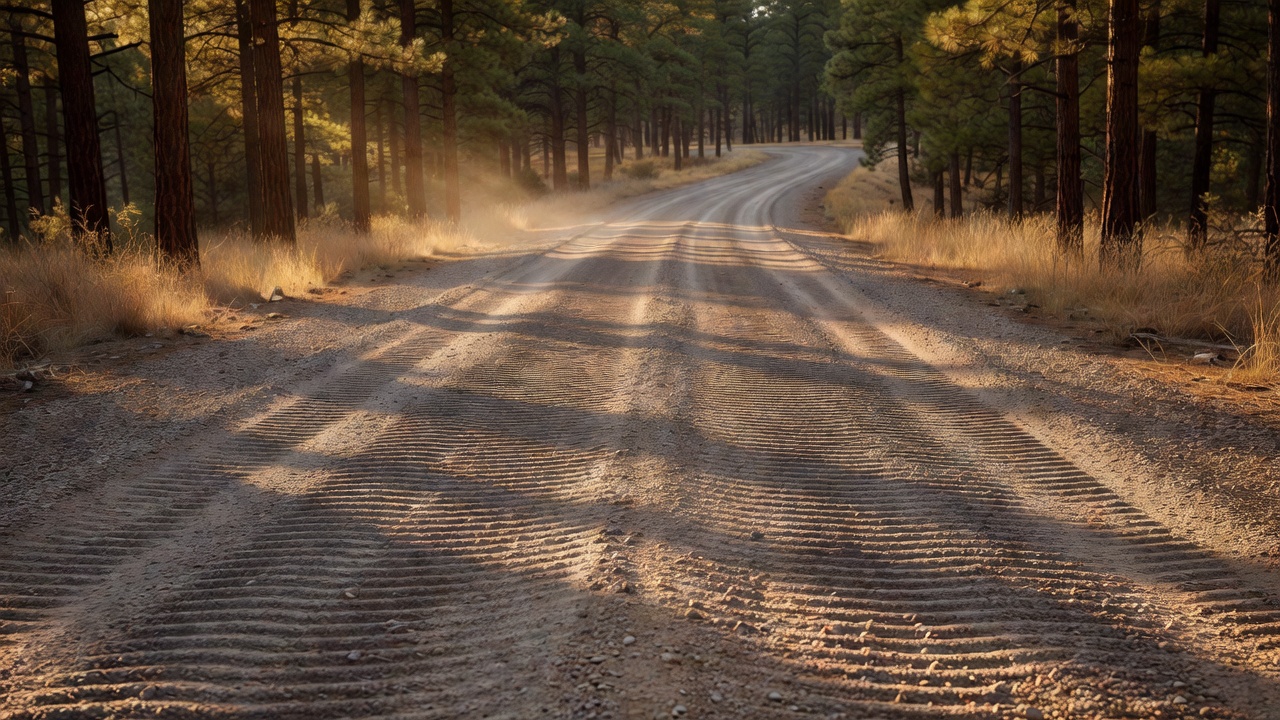
Washboard
The regular crossways ripples that form in the surface of a dirt or gravel road -- ridges and troughs marching down the road like the ribs of a laundry washboard, buzzing through your seat and your fillings -- and it is not a sign the road was built badly: it is what bouncing tires do to dry surface gravel that has lost the fine material binding it together, which is why it shows up worst exactly where everyone accelerates, brakes and corners, and why the only honest cures are a grader with damp material and a lighter right foot.
In the field
The engineering name for it is corrugation, and the EPA-hosted unpaved-roads maintenance manual defines it about as plainly as anyone has: "a series of ridges and depressions across the road surface caused by the lack of surface cohesion." That lack of cohesion "is a result of the loss of fines in the road surface which, in turn, is usually a result of very dry conditions within the road surface," and the conditions "are aggravated and enhanced by excessive vehicle speeds and high traffic volumes." Translation: good gravel is a blend of rock and fine dust, and the dust is the glue. Bake the glue out in July, drive on it, and the loose stone on top stops being a surface and starts being a pile of marbles a tire can shove around.
The shoving is the whole mechanism. A tire hits a small bump, hops, comes down a short distance later and pushes a little gravel forward into a fresh ridge; the next tire hops off that one and lands further along, and a few hundred vehicles later the road has learned a rhythm. It kicks in above a threshold speed -- roughly 5 mph in dry granular material -- which is the point where the wheel begins to bounce instead of roll. Two details make it click. First, a passive, non-driving wheel is enough to do it, so this isn't your throttle spinning gravel; a towed trailer builds washboard just fine. Second, the dominant mechanism is displacement of material rather than ejection -- the gravel gets pushed into ripples, not thrown out of them. Which is also why your tires aren't wearing it smooth as you drive. Every pass is another vote for the pattern.
For your trip, treat washboard as a traction problem wearing a comfort problem's clothing. When your tires are spending part of every cycle unweighted at the top of a ripple, they are not fully doing the two jobs you need most on a loose surface: steering and stopping. The plain-language version is that a washboarded road "creates an uncomfortable ride for the occupants of traversing vehicles and hazardous driving conditions for vehicles that travel too fast to maintain traction and control." The Forest Service's own driving guidance points the same direction without ever using the word: "Forest Service roads can be narrow, rocky, and are not meant for high speeds," and "be careful braking on gravel roads -- allow more time and distance when coming to a stop." Add a washboarded surface to a gravel road's already-long stopping distance and you have the classic way a trip goes sideways: a corner, a logging truck, and a set of tires that were only touching the road part-time.
Now the catch, because this is where nearly everybody gets it wrong. There is no magic speed that makes washboard disappear, and "just get up on top of it" is the single most repeated piece of bad advice in dirt-road driving. It feels smoother because you are skimming the crests -- and that is precisely the problem. Jackson County, Oregon's road department, which grades this stuff for a living, puts it in one sentence: "Do not speed up to 'skip over' washboards -- this reduces tire contact and increases crash risk." You have traded a rough ride for less rubber on the ground, on a surface where grip is already the scarce commodity. The same county notes that "speeds under 3 MPH do not generate washboard -- but that's impractical," and that "keeping speeds under 20 MPH will significantly slow washboard development." Take that 20 for what it is -- an Oregon county's guidance for its own gravel roads, not a national forest rule -- but the direction it points is real, and it happens to be the same direction as your own safety. Slower is the answer both for the road and for you. If the corrugation is violent enough that slowing down isn't enough, the honest move is a different road or a different day, not more speed.
Why is it never fixed? Partly budget, partly timing, and the timing part is genuinely counterintuitive. Dragging a blade over dry washboard mostly just relocates loose rock: "when the causative problem is of loss of fines, blading alone is not recommended. The problem will only recur shortly thereafter." The real repair is to scarify the surface while it is damp, re-mix it with a good percentage of fines, regrade, re-establish the crown and compact it. Grading dry is worse than useless -- the same manual calls it "futile" and "often a causative factor" in washboarding, and advises crews to avoid blading during extended dry periods. So the peak of washboard season is also the worst time to fix it, and forest roads get in line behind that: the Forest Service says its roads "may be infrequently maintained," that "maintenance of designated roads, trails, and areas will depend on available resources, and many may receive little maintenance," and that a road being on the map "should not be interpreted as ... an implication that the road, trail, or area is passable, actively maintained, or safe for travel."
Two last practical notes. Washboard is a condition, not a classification -- it does not live in the MVUM or the maintenance-level rating, so a road rated for a standard passenger car can be beaten into corrugation the month after it was graded and rated exactly the same on paper. It is weather- and traffic-dependent, and it varies by forest, by district and by how long it has been since rain, which is why the only current information is a call to the ranger district. And it is common enough that land managers list it right alongside mud and potholes when they report road conditions: e.g. Mojave National Preserve's July 6, 2026 road report flags "some washboard and debris from recent rains" on Black Canyon Road and rates the Kelso Dunes road "Rough Washboard and potholes; High clearance vehicles only." When an agency bothers to write the word down, believe it.
See also
Put it to use
Sources
- U.S. EPA (hosting) -- Recommended Practices Manual: A Guideline for Maintenance and Service of Unpaved Roads (Choctawhatchee, Pea and Yellow Rivers Watershed Management Authority, Feb. 2000): 'Corrugating/"washboarding" is a series of ridges and depressions across the road surface caused by the lack of surface cohesion ... a result of the loss of fines ... aggravated and enhanced by excessive vehicle speeds and high traffic volumes.'; repair = scarify while damp, re-mix fines, regrade, re-crown, compact; 'blading alone is not recommended'; dry blading is 'futile'
- Wikipedia -- Washboarding: 'the formation of periodic, transverse ripples in the surface of gravel and dirt roads'; forms in 'dry, granular road material with repeated traffic, traveling at speeds above 8.0 kilometres per hour (5 mph)'; a passive non-driving wheel suffices and 'displacement of material, rather than ejection, is the dominant mechanism'; 'hazardous driving conditions for vehicles that travel too fast to maintain traction and control'
- Jackson County, Oregon Roads Department -- Gravel Roads: 'Washboarding occurs when wheels move aggregate into ripples; the faster the speed, the more movement occurs.'; 'areas where drivers accelerate or brake hard are especially prone to corrugation'; 'Keeping speeds under 20 MPH will significantly slow washboard development.'; 'Do not speed up to "skip over" washboards -- this reduces tire contact and increases crash risk.' (county guidance, not a federal rule)
- U.S. Forest Service -- Know Before You Go: Driving: 'Forest Service roads can be narrow, rocky, and are not meant for high speeds.'; 'Be careful braking on gravel roads. Allow more time and distance when coming to a stop.'
- U.S. Forest Service -- Green Mountain & Finger Lakes NFs, Driving on Forest Roads: 'Most of the National Forest roads are gravel and are intended for low-speed travel.'; roads 'may be infrequently maintained with possible rocks, ruts, washouts, downed trees and encroaching brush.'
- U.S. Forest Service -- About the Forest Service Visitor Map: designation 'should not be interpreted as ... an implication that the road, trail, or area is passable, actively maintained, or safe for travel.'; 'Maintenance of designated roads, trails, and areas will depend on available resources, and many may receive little maintenance.'
- National Park Service -- Mojave National Preserve, Alerts & Conditions road report (July 6, 2026): 'Some washboard and debris from recent rains.' (Black Canyon Rd); 'Kelso Dunes: OPEN, Rough Washboard and potholes; High clearance vehicles only.'