Stage 1 and Stage 2 fire restrictions
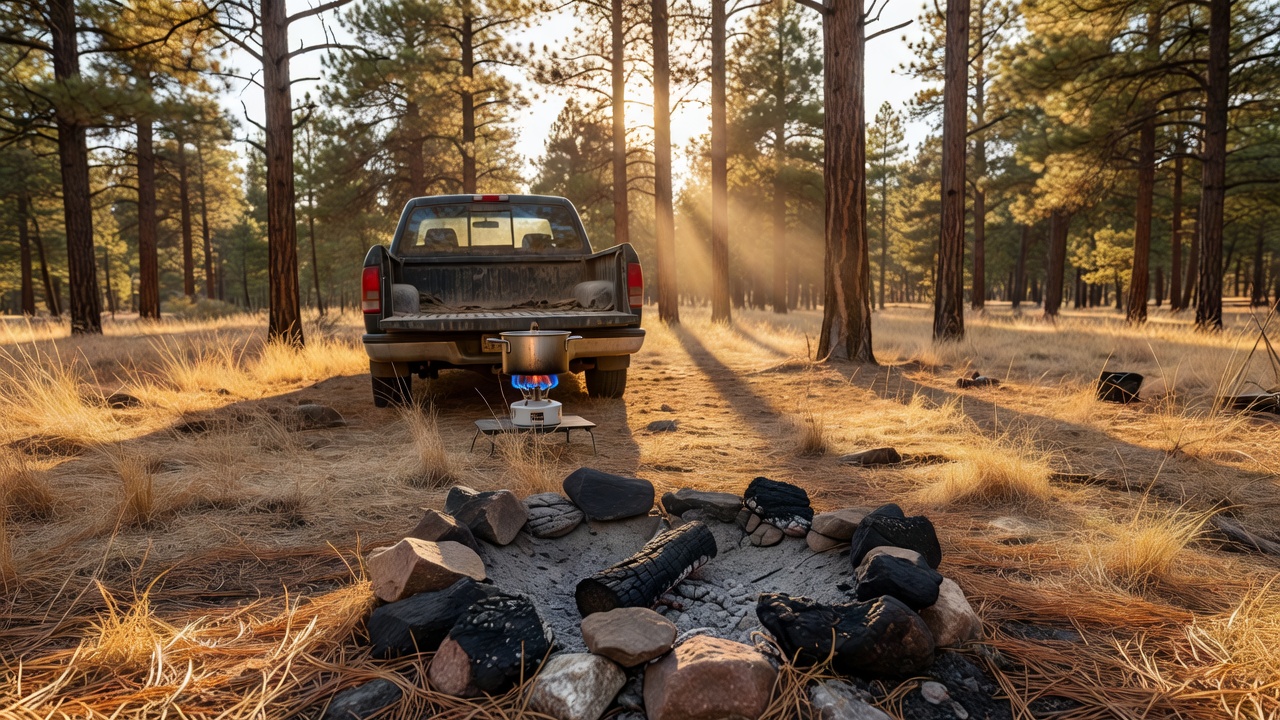
Stage 1 and Stage 2 are the two rungs of a ladder a land agency climbs as the woods dry out: Stage 1 usually kills your campfire everywhere EXCEPT an agency-built fire ring in a developed site, Stage 2 kills it everywhere including the campground -- and under both, a propane or liquid-fuel stove with an on/off valve is typically still legal, because a flame you can shut off in one second is not what starts wildfires. There is no national definition of the stages, though: each forest writes its own order, so "Stage 1" means exactly what that forest's order says it means.
In the field
For your trip, the translation is blunt. Stage 1 means plan to COOK, not to sit around a fire -- unless you're in a developed campground with an agency-installed ring or grill, which is normally the one place a wood fire survives Stage 1. Eldorado National Forest puts it in one line: wood and charcoal fires "allowed only in designated developed campgrounds." San Juan National Forest's Stage I is the same shape -- fires in Forest Service-installed pits at campgrounds are fine, so are pressurized-fuel stoves. Stage 2 removes even that. Colville National Forest doesn't hedge: "FIRES ARE NOT ALLOWED ANYWHERE on the Colville National Forest." Eldorado's Stage 2: "No Fires are allowed in the forest including the campgrounds." And Stage 2 usually drags other gear in with it -- Coconino bans chainsaws and generators from 9 AM to 8 PM, Central Oregon's Stage 2 adds chainsaws, smoking outside a vehicle, and off-road driving. If a forest goes to Stage 3, that's not a restriction anymore, that's a closure: public entry to the area is prohibited outright.
The stove exemption is the single most useful thing to know, and it's worth learning the exact words, because the words are the rule. Colville's Stage 2 leaves you "pressurized or bottled liquid fuel devices with functioning shut-off valves" used in a cleared area. Olympic's Stage 1 allows a "cook stove, lanterns or campfire fueled solely by gas, jellied petroleum or pressurized liquid fuel or propane with an on/off switch and flammable vegetation is cleared a minimum of 3-feet away from open flame on all sides." Central Oregon allows "liquid and pressurized gas stoves, lanterns and fire pits with an on and off switch." Notice what all three are actually testing for: a valve. Turn the knob, the fire is out. That's the whole logic, and it's why your backpacking stove keeps working through a fire ban that shut down every fire ring on the district.
Which sets up the way people get burned. Charcoal is not a stove. Coconino's order prohibits "igniting, building, maintaining, or using a fire, including charcoal and briquettes" -- and Central Oregon's Stage 2 explicitly names "wood stoves and charcoal briquette fires" as open fires. A twig stove, a pellet grill, a briquette chimney: all fires. Then read which FUELS your forest actually exempted, because they don't all match. Coconino's exemption covers a stove or grill "solely fueled by pressurized liquid petroleum or pressurized liquid petroleum gas (LPG) fuels" -- narrower, as written, than Olympic's, which names jellied petroleum and pressurized liquid fuel too. And in California there's a second document entirely: Eldorado says gas stoves and lanterns are legal in the general forest "when in possession of a valid Campfire Permit," under BOTH stages. A legal stove and no permit is still a citation.
Now the catch that explains all the others. Pull up the actual federal regulation -- 36 CFR 261.52, the fire section -- and it opens "When provided by an order, the following are prohibited," then lists the raw ingredients: "(a) Building, maintaining, attending or using a fire, campfire, or stove fire," smoking, fireworks, running an internal combustion engine, welding, no spark arrester. That's it. The words "Stage 1" and "Stage 2" do not appear anywhere in it. The stages are a convention -- a menu the agencies picked from and standardized regionally so the rules read the same across a dispatch area -- and the legally binding thing is the signed forest order, not the number. Coconino notes the Forest Supervisor "retains the authority to issue campfire/smoking and chainsaw restrictions" and coordinates with adjacent forests before doing it. So "we're in Stage 2" is shorthand for a specific document, and the document is what a law enforcement officer reads.
Two more things that cost people real money. One: restrictions stop at the property line. San Juan says plainly that restrictions vary by jurisdiction and by area within the forest, and Central Oregon's otherwise-unified Stage 2 still carves out specific BLM river corridors. National forest, BLM, state, county and tribal land are separate jurisdictions issuing separate orders -- a boundary you can't see on the ground can absolutely be the line between a legal campfire and a fine. Two: they move FAST, in both directions. These are dated orders with a rescind clause -- Olympic's Stage 1 ran "from June 26th, 2026, 12:01 am, through September 30th, 2026 unless rescinded" -- and the criteria behind them (San Juan lists "current and predicted weather, number of resources available to fight fires, fuel moisture in the forest, fire behavior and containment challenges") can flip inside a week. A forest can go to Stage 2 while you're already out there, and one good soaking can drop it back off. Also don't confuse the color-coded FIRE DANGER sign with restrictions: San Juan keeps them deliberately separate -- danger is the forecast, restrictions are the rules. "Very High" on the sign doesn't ban anything by itself. Check the forest's alerts page the day you leave, not the week you planned.
See also
Put it to use
Sources
- Code of Federal Regulations -- 36 CFR 261.52, Fire (prohibitions apply "when provided by an order"; no stages named)
- U.S. Forest Service -- San Juan National Forest, Fire Danger Levels and Restrictions Explained (Stages I-III, criteria)
- U.S. Forest Service -- Coconino National Forest, Restrictions (Stage 1 / Stage 2 prohibitions and exemptions)
- U.S. Forest Service -- Colville National Forest, Fire Restrictions (Stage 2: "fires are not allowed anywhere")
- U.S. Forest Service -- Olympic National Forest, Stage 1 Fire Restrictions (on/off switch + 3-foot clearance wording)
- U.S. Forest Service -- Eldorado National Forest, Fire Restriction Status (California Campfire Permit for stoves)
- U.S. Forest Service -- Deschutes National Forest, Public Use Fire Restrictions (Central Oregon interagency Stage 2)