Boondocking power
Everything that keeps your lights, fridge and laptop running when there is nothing to plug into -- a battery to hold the energy, some mix of solar panels and your vehicle's alternator to put it back, and an inverter if you need household outlets -- and the honest truth is that sizing it is arithmetic, not shopping: the watt-hours you spend each day have to be less than the watt-hours you can reliably put back on the shortest, cloudiest, parked-all-day version of your trip, not the sunny one you pictured.
In the field
Start with the unit, because almost every bad decision here starts with the wrong one. A watt is how hard something is pulling right now; a watt-hour is how much you actually used. The EIA puts it about as plainly as possible: watts "measure power at a specific moment," while "one Watthour is the energy of one Watt used for one hour" -- so "if you use a 40-Watt (0.04 kW) light bulb for five hours, you have used 200 Wh, or 0.2 kWh, of electrical energy." Your whole power system is that sentence run backwards. Write down every load, guess its hours honestly, add up the watt-hours, and you have a daily number. Everything after this is about covering that number. Note which loads run around the clock -- a fridge that never sleeps will usually outweigh every gadget you charge in the evening, so it is the appliance that decides the size of your system, not the one you think about most.
The battery is where the energy waits, and the number on the label is not the number you get to spend. Traditional lead-acid comes in two flavors that look identical and are not: a starting battery is "designed to deliver only a small part of their capacity in a short, high-current burst for starting an engine," while a deep-cycle battery has "thicker active plates, with higher-density active paste material and thicker separators" so it can be "regularly deeply discharged using most of its capacity." Even then you pay for depth: there is "an inverse correlation between the depth of discharge (DOD) of the battery and the number of charge and discharge cycles it can perform," and the usual compromise cited is "an average depth of discharge of around 50%." Which is the first thing beginners get wrong -- a 100 amp-hour lead battery is, in practice, a 50 amp-hour battery you are allowed to buy twice. Two more lead-acid facts worth knowing: capacity itself "varies according to how quickly it is discharged" (Peukert's law -- pull hard and you get less), and leaving it flat is what kills it, because lead-acid batteries "lose the ability to accept a charge when discharged for too long due to sulfation, the crystallization of lead sulfate."
Lithium iron phosphate -- LiFePO4, or just LFP -- is the chemistry that changed the math, and its advantages are real rather than marketing. Cycle life is rated "from 2,500 to more than 9,000 cycles depending on conditions" against roughly 1,000 to 2,300 for the nickel-based lithium chemistries, and its headline feature is "thermal and chemical stability, which contributes to improved battery safety." It is also far lighter for the energy: LFP runs about 205 Wh/kg at the cell level, where lead-acid sits at 35-40 Wh/kg. It gives up energy density to the NMC and NCA chemistries in your phone and your EV (those clear 300 Wh/kg), which is exactly the trade you want in a vehicle you sleep in. LFP cells are 3.2 V nominal, so four in series make the 12.8 V pack everyone calls "12 volt."
Here is the catch nobody mentions in the sales copy: cold. "Many types of lithium-ion cells cannot be charged safely below 0 C, as this can result in plating of lithium on the anode of the cell," and from 0 to 5 C "charging is possible, but the charge current should be reduced." Plated lithium grows dendrites, which "can accumulate and pierce the separator, causing a short circuit" -- this is a damage mechanism, not a warranty technicality. Note the asymmetry: the limit is on charging, not on using the battery. So the failure mode on a frosty October morning at 8,000 feet is a pack that will happily run your heater but refuses the perfectly good sunshine hitting your roof, and a battery management system (BMS) doing its job by blocking the charge is the system working, not breaking. If you camp in shoulder season, that is a question to ask before you buy, not after.
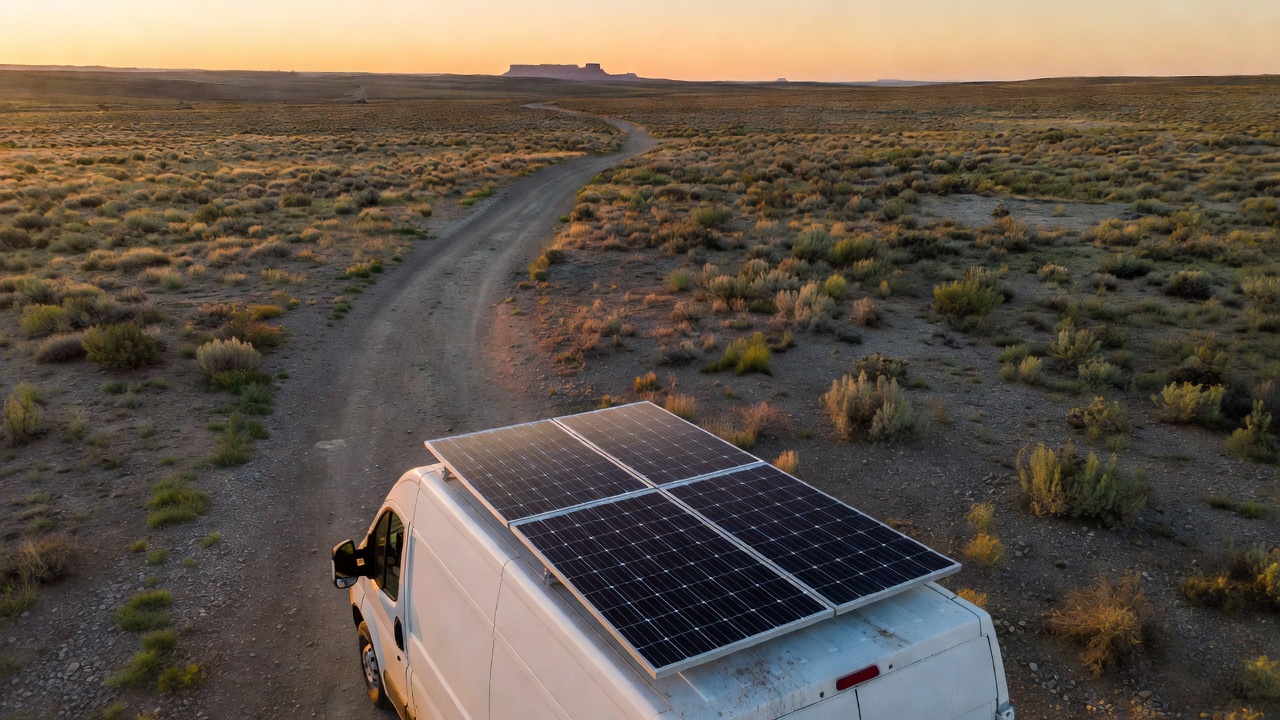
Solar is the most oversold and most useful thing on the roof at the same time. A panel's rating is a laboratory number: efficiencies "are obtained by exposing the cell to a constant, standard level of light while maintaining a constant cell temperature." Your camp is not a laboratory. Panels get hot, and "higher temperatures cause the semiconductor properties to shift, resulting in a slight increase in current, but a much larger decrease in voltage." The sky is the bigger variable: only sunlight that reaches you "without being diffused" is direct beam radiation, and "atmospheric conditions can reduce direct beam solar radiation by 10% on clear, dry days and by 100% during thick, cloudy days." And the season swamps everything -- Denver, at about 40 degrees latitude, "receives nearly three times more solar energy in June than they do in December." So the panel that runs your whole life in the Utah desert in June is a trickle charger in a Pacific Northwest forest in November. Size solar for the trips you actually take in the months you actually take them, and remember that a shady creekside site -- the one you want -- is a bad solar site by definition.
Your engine is the other charger, and it is the one people forget they already own. Drive days are charging days; parked days are not. The catch is that you can no longer assume a steady voltage at the back of the vehicle. Alternators need "a voltage regulator which operates by modulating the small field current to produce a constant voltage at the battery terminals," but in "modern designs" that regulator is gone as a separate part -- "voltage regulation is now a function of the engine control unit (ECU)," and "alternator regulators are linked to the vehicle's computer system" where "air temperature obtained from the intake air temperature sensor, battery temperature sensor and engine load are evaluated in adjusting the voltage supplied by the alternator." In other words, your truck is charging its own starting battery to its own satisfaction, on a schedule set by a computer that has never heard of your house battery. That is the whole reason the DC-DC charger exists as a product category: it takes whatever the vehicle offers and produces the charge profile your house battery actually wants, instead of hoping the two agree. Whatever you wire up, wire it so the house loads cannot flatten the battery that starts the engine -- out here, that battery is your ride home.
Last, the part that is about the campsite rather than the hardware. Out on dispersed land there is nothing to plug into, full stop; the Forest Service says it in one line: "You need to be self-contained. No amenities are provided; such as water, restrooms or trash cans." (Stay limits are "usually 14 days, but this can be further limited in some National Forest areas" -- rules vary by forest and district, so check the one you are going to.) Nor does a developed campground necessarily save you: plenty of national-forest campgrounds are standard nonelectric sites, and the generator you brought as plan B runs on locally posted hours. At Gone Creek Campground on Mt. Hood National Forest, for example, "generator use is permitted from 8:00 AM to 8:00 PM" and "generators are PROHIBITED after 8 PM and before 8 AM including to power medical devices or other equipment." Those hours are that campground's rule, not a national one, and they differ from forest to forest and park to park -- but the pattern is nearly universal, and it lands squarely on the two times you most want to make power: first thing in the morning and after dark. Plan for a battery that carries you overnight on its own, and the rest of this gets easy.
See also
Put it to use
Sources
- U.S. EIA -- Electricity explained: Measuring electricity: watts 'measure power at a specific moment'; 'One Watthour is the energy of one Watt used for one hour'; 'if you use a 40-Watt (0.04 kW) light bulb for five hours, you have used 200 Wh, or 0.2 kWh, of electrical energy.'
- U.S. Dept. of Energy (EERE) -- Solar Radiation Basics: direct beam vs diffuse radiation; 'Atmospheric conditions can reduce direct beam solar radiation by 10% on clear, dry days and by 100% during thick, cloudy days.'; 'Denver, Colorado, (near 40 degrees latitude) receives nearly three times more solar energy in June than they do in December.'
- U.S. Dept. of Energy (EERE) -- Solar Performance and Efficiency: ratings measured under a 'constant, standard level of light while maintaining a constant cell temperature'; 'Higher temperatures cause the semiconductor properties to shift, resulting in a slight increase in current, but a much larger decrease in voltage.'
- Wikipedia -- Deep-cycle battery: designed 'to be regularly deeply discharged using most of its capacity'; 'an average depth of discharge of around 50%'; 'an inverse correlation between the depth of discharge (DOD) of the battery and the number of charge and discharge cycles it can perform'; thicker plates vs starting batteries
- Wikipedia -- Lead-acid battery: starting batteries 'are not designed for deep discharge'; 'Repeated deep discharges will result in capacity loss and ultimately in premature failure'; sulfation when 'discharged for too long'; specific energy 35-40 Wh/kg; capacity 'varies according to how quickly it is discharged' (Peukert's law)
- Wikipedia -- Lithium iron phosphate battery: 'Nominal cell voltage: 3.2 V'; approx. 205 Wh/kg at cell level vs NMC over 300 Wh/kg; 'Cycle life from 2,500 to more than 9,000 cycles depending on conditions'; 'thermal and chemical stability, which contributes to improved battery safety'
- Wikipedia -- Lithium-ion battery: 'Many types of lithium-ion cells cannot be charged safely below 0 C, as this can result in plating of lithium on the anode of the cell'; 0-5 C charging 'possible, but the charge current should be reduced'; dendrites 'can accumulate and pierce the separator, causing a short circuit'
- Wikipedia -- Alternator (automotive): 'a voltage regulator which operates by modulating the small field current to produce a constant voltage at the battery terminals'; 'Modern designs do away with the voltage regulator altogether; voltage regulation is now a function of the engine control unit (ECU).'; regulators 'linked to the vehicle's computer system' adjusting voltage by intake air temperature, battery temperature and engine load
- USDA Forest Service, Pacific Southwest Region -- Dispersed Camping: 'You need to be self-contained. No amenities are provided; such as water, restrooms or trash cans.'; stay 'usually 14 days, but this can be further limited in some National Forest areas'
- Recreation.gov -- Gone Creek Campground, Mt. Hood National Forest (standard nonelectric sites): 'Generator use is permitted from 8:00 AM to 8:00 PM.'; 'Generators are PROHIBITED after 8 PM and before 8 AM including to power medical devices or other equipment.' (one campground's posted rule, not a national one)