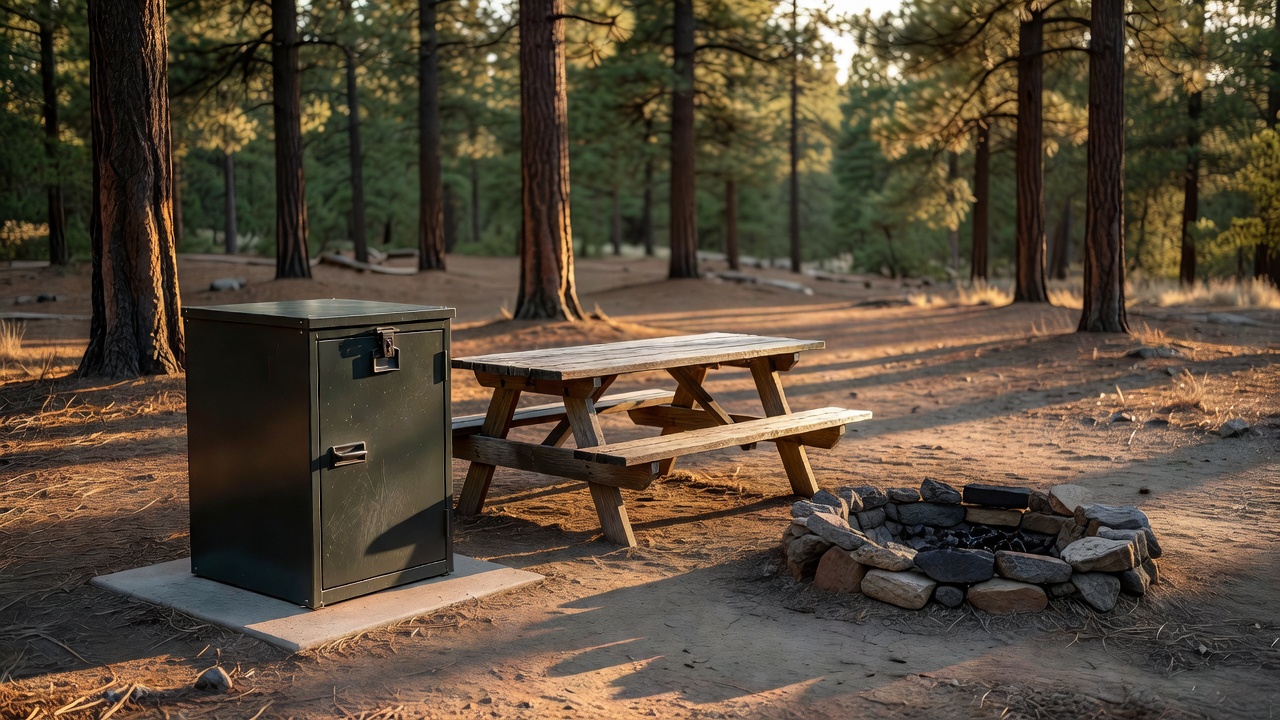
Food storage order (and bear boxes)
A food storage order is a signed order from a forest supervisor -- or the equivalent regulation in a national park -- that turns "secure your food" from campfire advice into federal law, with a Class B misdemeanor and a fine of up to $5,000 behind it; a bear box is the heavy steel locker the agency bolts down at the campsite so you have an easy way to obey it.
In the field
What it means for your trip is that compliance stops being a judgment call and becomes a checklist. Where an order is in effect, it names a short, closed list of ways your food may legally exist, and anything not on that list is a violation even if nothing goes wrong. On the White River National Forest in Colorado, for example, the acceptable options are: attended by an awake adult within 100 feet and in line of sight; inside a Forest Service-provided container at a developed site; inside a bear-resistant container certified by the Interagency Grizzly Bear Committee; locked in a vehicle whose storage compartment is solid and has no openings a bear could get through; inside a hard-sided building; or "suspended at least 10 feet off the ground at all points and 4 feet horizontally from any supporting tree." The Beaverhead-Deerlodge in Montana reads almost identically, right down to the 100-foot line-of-sight rule -- and adds that a horse or livestock trailer counts only if it has no openings greater than 10 inches in two dimensions.
The bear box is the agency's own answer to its own rule. It's a steel chest or cabinet, usually bolted to a pad, either one per site or shared at a trailhead. Yosemite has metal food lockers "in every campsite, most trailhead parking areas, and at lodging areas with tent cabins," and publishes the dimensions -- the standard one is 33 inches deep by 45 wide by 18 tall, while newer campground lockers run 35 by 43 by 28. Measure your cooler before you assume it fits, because a full-size chest cooler and an 18-inch-tall locker are a bad surprise to discover after dark. Two more things people get wrong on shared boxes: Sequoia and Kings Canyon says flatly that "locks are not permitted on them," and that caching food and gear in a food storage box is not allowed. The box is a place to sleep your food, not a storage unit.
Here's the catch, and it's the whole ballgame: there is no national food storage rule. Each one is a local order with its own boundary, its own season and its own numbers, and the numbers genuinely differ. Ten feet up and four feet out satisfies White River and the Northern Region's Northern Continental Divide order. The Boundary Waters wants 12 feet up and 6 feet out. The Inyo's counter-balance spec is 15 feet up and 10 feet horizontally from the trunk -- and across the wilderness areas it names, including the John Muir and Ansel Adams, a certified container is required outright. Yosemite goes further and says "hanging food is illegal throughout Yosemite," full stop. Sequoia and Kings Canyon requires containers May 1 through October 31 in five named places and notes that the counterbalance "generally does not work in these parks." So "I know how to hang a bear bag" is not a universal answer, and the skill you learned on one forest can be a citation on the next one.
Two more ways people trip over this. First, "food" is defined far wider than food. The Beaverhead-Deerlodge order explicitly covers personal hygiene products, beverages, and empty food or beverage containers; the Boundary Waters names soap, lip balm and toothpaste; Yosemite's list runs to sunscreen, mosquito repellent, deodorant, medications and feminine products. The empty ones matter -- a rinsed can still smells like dinner to a nose that good. Hunters and horse packers have their own clauses: the NCDE order reaches game carcasses within a half-mile of camp and livestock feed, exempting plain baled or cubed hay. Second, these orders are not just grizzly country and not just wilderness. Mt. Baker-Snoqualmie has one covering the entire forest; the Boundary Waters order runs April 1 to November 30 every year. And note that "IGBC-certified" shows up in orders far outside grizzly range, because the Interagency Grizzly Bear Committee's product list became the standard everybody borrowed -- if a cooler or canister isn't on it, a ranger has no reason to believe your marketing copy.
Practical bottom line: orders expire and get reissued on their own clocks -- White River's runs through the end of 2029, the Inyo's to June 2027, the Boundary Waters' to 2031 -- and the boundaries get redrawn each time. Nobody sends you a notice. Before a trip, pull up the managing forest's or park's own alerts page and read the current order, because that document, not a blog post and not this entry, is what the ranger is enforcing. AA maps where the campsites are; the food storage order for that ground comes from the agency that owns it.
See also
Put it to use
Sources
- USDA Forest Service Northern Region -- Order R1-2023-02, NCDE Food and Wildlife Attractant Storage Order (attractant definition; IGBC certified list; 10 ft up / 4 ft out; carcasses and livestock feed; penalties)
- USDA Forest Service -- White River National Forest Food Storage Order (the six acceptable storage methods; 100 ft awake and line-of-sight; May 15-Oct 1 season; Class B misdemeanor)
- USDA Forest Service -- Beaverhead-Deerlodge National Forest Annual Food Storage Order (hygiene products, beverages and empty containers; closed vehicle/trailer spec; 10-inch trailer opening limit)
- USDA Forest Service -- Mt. Baker-Snoqualmie National Forest, Entire Forest Under Food Storage Order 06-05-25-01 (forest-wide scope; Apr 2025-Apr 2027 duration; penalties)
- USDA Forest Service -- Superior National Forest, BWCAW Bear Aware Food Storage Order 09-09-26-02 (12 ft up / 6 ft out; Apr 1-Nov 30 restricted season; scented items; 36 CFR 261.58(cc))
- USDA Forest Service -- Inyo National Forest, Food and Refuse Storage Restrictions, Order 05-04-50-23-03 (container-required wilderness areas; 15 ft / 10 ft counter-balance alternative)
- National Park Service -- Yosemite, Bearproof Food Lockers (locker locations and exact dimensions; keep closed and latched)
- National Park Service -- Yosemite, Bears & Food Storage While Backpacking (what counts as 'food'; hanging food is illegal throughout Yosemite)
- National Park Service -- Sequoia & Kings Canyon, Wilderness Food Storage (five container-required areas May 1-Oct 31; no locks on food storage boxes; no caching)